
Warrior-Scholar Project Boot Camp at Columbia University Builds Confidence for Veterans Preparing for College
The weeklong intensive in Morningside Heights helps participants build the confidence and skills to succeed in a college environment.
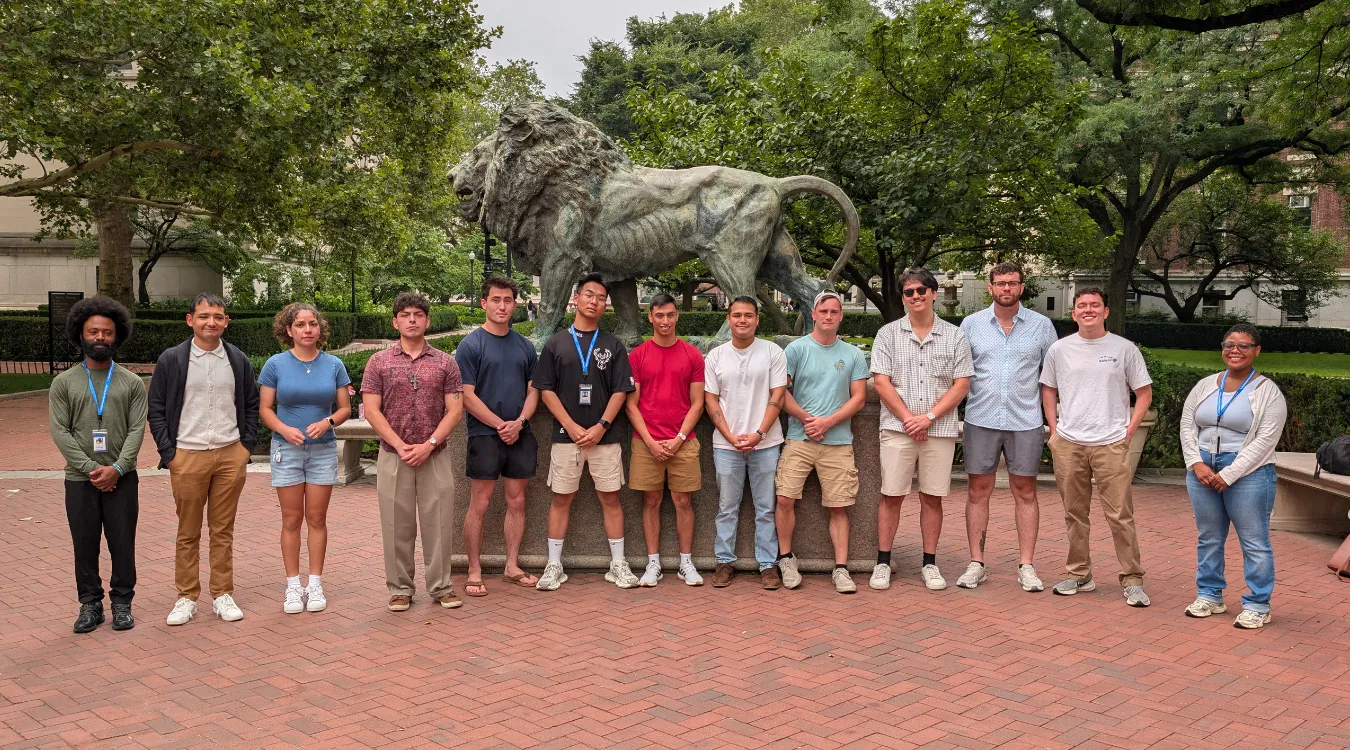
The transition from military service to college can feel daunting, but for one week each summer the Warrior-Scholar Project (WSP) Academic Boot Camp helps enlisted service members and veterans rediscover what they're capable of in the classroom. Last week, participants from across the country came to Columbia University to take part in the boot camp, a rigorous, weeklong experience designed to simulate the demands of a college "finals week."
Now in its ninth year at Columbia, the program immerses participants in more than 75 hours of intensive coursework. They learn from Columbia faculty, work with tutors, and receive guidance from student-veteran mentors while strengthening their critical reading, writing, and discussion skills.
As Columbia GS Dean Lisa Rosen-Metsch engaged with participants throughout the week, she saw firsthand the sense of purpose and confidence the program fosters.
"We are delighted to welcome the ninth cohort of Warrior-Scholar Project participants to the Columbia University campus," Rosen-Metsch said. "It is a true privilege to see the students in this program experience such transformative growth in such a short time; the results are truly amazing. We are so grateful to all of our incredible WSP colleagues for their partnership."
For Richard John, Professor of History and Communications at the Columbia Journalism School and WSP seminar instructor, the experience is as rewarding for faculty as it is for participants.
"I look forward each summer to participating in the Warrior-Scholar Project," John said. "The students are always curious, well prepared, and engaged—and bring to our discussions perspectives rooted in a wide range of real-world experiences that set them apart from most of our undergraduates."
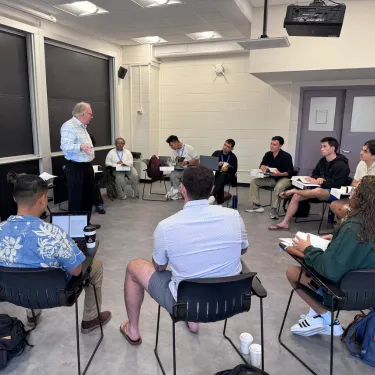
One of those students was Marine Corps Sgt. Arthur Khanlian, who arrived in Morningside Heights after nearly seven years away from the classroom, unsure what to expect.
"As a high school student I had a dismal GPA, but after examining what I wanted in life and seeing the higher education opportunities that being in the military affords, it was a no-brainer that higher education was something I wanted to pursue," he said.
Initially, Khanlian expected the boot camp to focus primarily on the college admissions process. Instead, he found himself immersed in the kind of rigorous coursework he'll encounter when he begins his studies in political science at Columbia GS this fall. “The thing that I found most surprising was how engaging the faculty who facilitated our lessons were,” he said. “Prior to participating in the WSP bootcamp I imagined college level courses as long boring lectures where professors droned on and on about the subject they were teaching. I was surprised that the lessons we were in required active group discussions.”
By the end of the week, Khanlian walked away with more than a new perspective on college-level learning. "Participating in WSP has instilled confidence in me that I'll be successful in higher education," he said.
That growing confidence was a common theme among WSP participants. James Kallus, a Marine Corps veteran who served eight years as a Fire Support Marine and Joint Terminal Attack Controller, started the bootcamp hoping to sharpen his academic skills after years away from the classroom.
"Participating in WSP has instilled confidence in me that I'll be successful in higher education,
"I really wanted to regain my academic abilities in analytical reading and complex writing," he said. "I was shocked by the caliber of Columbia's faculty; every professor could keep the coursework engaging and pull from a huge wealth of knowledge. The greatest takeaway, however, is definitely the renewed confidence I have gained in my ability to tackle advanced coursework."
Kallus, who will also enroll at Columbia GS this fall, said he hopes other service members recognize the value of continuing their education. "There is never any harm in continuing to pursue greater knowledge," he said. "It can improve your standing in the world and be a great resource that you can provide to those in your charge."
The program offered something equally valuable to Navy veteran Nate Hazy: the opportunity to determine whether college was the right next step. "On top of giving you the confidence to know you can succeed, another aspect of this project is to see if school is right for you," he said.
For Hazy, the experience confirmed his passion for learning and encouraged him to explore new academic interests, like climate science and mechanical engineering. "The best thing you can do for yourself is get educated and understand how to engage with your world," he said.
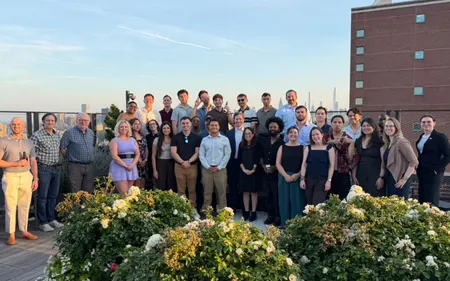
Like Khanlian and Kallus, Hazy will also begin his studies at GS in the fall and echoed that the program offered more than academic preparation. Alongside the rigorous coursework, WSP participants build lasting relationships with fellow veterans, faculty, tutors, and student-veteran mentors—creating a support network that extends well beyond the weeklong experience.
John added that he was especially pleased to learn that several participants will be joining the Columbia community this fall. "I look forward to following their progress in the years to come," he said.
For Khanlian, Kallus, and Hazy, the Warrior-Scholar Project was more than a week of academic preparation—it was the beginning of their Columbia journey.