
Columbia University Honors Retired Admiral Michael G. Mullen and Celebrates Student Veterans at Annual Military Ball
Columbia University celebrated its veteran community at the annual Military Ball.
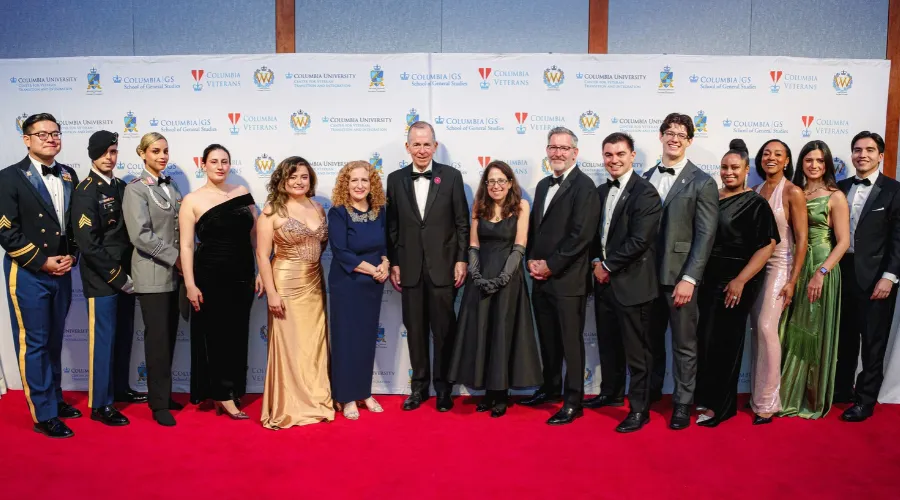
Nearly 700 students, alumni, faculty, administrators, sponsors, and donors filled Pier Sixty along the Chelsea waterfront last Friday for the Columbia University Military Ball—one of the largest events in its history. The atmosphere buzzed with camaraderie and pride as attendees not only honored those who served, but also invested in their futures, raising essential funds for academic, financial, and career-transition programs that support service members and their families at Columbia and across the country.
Established in 2010, the annual event unites veterans from across Columbia and New York State, reflecting the longstanding commitment of the University and the School of General Studies (GS) to military-connected students. In her opening remarks, School of General Studies Dean Lisa Rosen-Metsch ’90GS emphasized that veterans are “central to who we are” at GS. Pointing to the School’s 1947 founding to serve returning World War II service members, Rosen-Metsch noted that 80 years later, this mission is “stronger than ever,” with nearly 500 U.S. and international veterans enrolled today—and further expanded with the creation of the Columbia University Center for Veteran Transition and Integration (CVTI) in 2017.
During the welcome remarks, Rosen-Metsch reflected on the mission of the CVTI. “Its work reflects the belief that remains essential to our mission: veterans should not have to carry the responsibility for transition alone. Universities, workplaces, and civilian communities have a responsibility to make integration possible,” she remarked. “Today, the ball supports student veteran scholarships, student and alumni veteran organizations and programming, and CVTI’s national work.”
“Our veterans make Columbia better. Their experiences deepen our conversations in the classroom, challenge our assumptions, and help all of us understand more about the world and our responsibilities within it,” Rosen-Metsch said. “That conviction has also shaped our work beyond Columbia.”
Few individuals exemplify this broader impact better than the night’s honoree, Admiral Michael G. Mullen (Ret.), who received the Peter J. Awn Lifetime Service Award from Columbia University President Jennifer L. Mnookin. Admiral Mullen’s participation in the 2010 World Leaders Forum, alongside then-University President Lee C. Bollinger, helped foster a renewed dialogue between higher education and the military on the role of ROTC, which was re-established at the University a year later following a nearly 40-year absence.
“With your help, and then-President Lee Bollinger’s commitment, we restored a relationship that had been ruptured for quite some time,” President Mnookin remarked. “Fifteen years later, that restoration serves as a powerful reminder of what principled engagement and action can accomplish, of what listening and learning with humility can achieve, and of what we stand to lose if we allow ties between universities and the military to weaken.”
In presenting the award, President Mnookin expressed deep admiration for Dean Awn’s legacy and his steadfast belief in students taking nontraditional paths to higher education. “He understood how much veterans did and could contribute and how important it was for Columbia to create opportunities worthy of their abilities,” she said. “Admiral Mullen, your leadership reflects that same powerful belief and the potential of those who serve—and the responsibility we all share to support their futures.”
After accepting his award, Admiral Mullen spoke about his past experiences working with veterans and their families across the country, emphasizing the importance of higher education in our current society. “In this time right now, despite all the pressure…we need Columbia University. We need the students who go here,” he implored. “Not just the veterans. We need the education for our country and the world, despite the pressure. And we will need veterans who come back here again after they leave.”
The Military Ball continues to be a proud Columbia and New York City tradition. It brings together generations of veterans, service members, families, and friends in a shared experience of pride and purpose. It also reminds the community that the support surrounding Columbia’s student veterans will extend far beyond their time on campus, and into a lifelong network of mentorship, community, and belonging.