
The GS Arts & Research Collective Celebrates its Fifth Year
The Collective’s founder, Advising Dean Kristy Barbacane, and four student participants share its empowering, community-building impact.
Advising Dean Kristy Barbacane founded the GS Arts & Research Collective in 2021 with the simple goal of showcasing GS students’ creativity by displaying selected works in the Peter J. Awn Student Lounge and Academic Resource Center. Entering its 2025-26 edition, the Collective is now a mainstay of GS student life, enlivening central GS campus spaces and empowering GS students to share their own work and develop a deeper appreciation of their peers’ ingenuity.
While its central purpose has remained stalwart, the Collective has broadened its scope, from welcoming alumni submissions, to expanding the mediums exhibited. “The biggest evolution [in the five years] is the breadth and variety of submissions,” shared Dean Barbacane. “For example, this year's exhibit includes sculpture, origami, music playlists, a screenplay, and film, in addition to painting, photography, and creative writing.”
“I believe the Collective fosters greater community within GS by prompting discussion and dialogue,” added Dean Barbacane. “On multiple occasions, students and staff have commented to me about the exhibit or specific works. I also think it is really special to give staff, faculty, and visitors to Lewisohn the opportunity to see the creativity and ingenuity of our students.”
As for her hopes for the future of the Collective, Dean Barbacane said, “This past summer, as I was taking down the 2024-25 exhibit, a student in the GS Lounge exclaimed ‘no, don't take down the artwork, I love it!’ I assured them that I was taking it down to put up a new exhibit and they were excited to hear this. I hope the exhibit continues to spark that appreciation and enthusiasm for the Collective and all of the inspiring works from our students.”
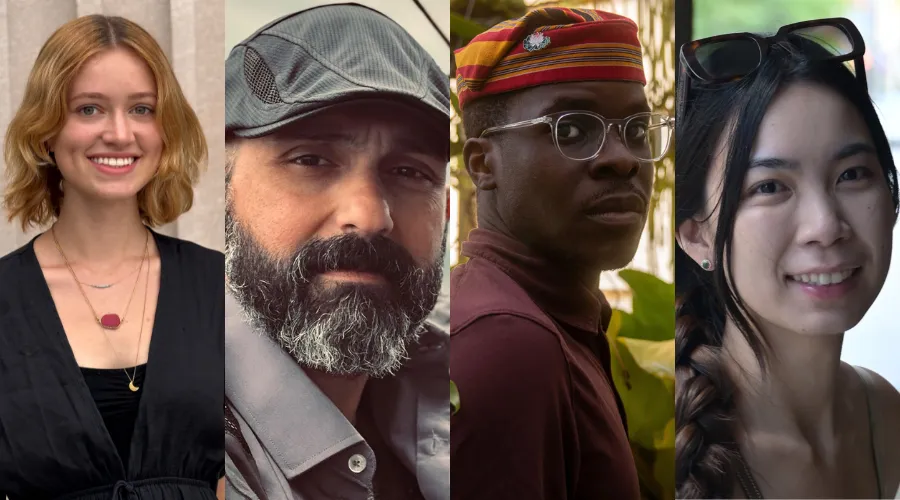
The 2025-26 participating students also hope their essays, films, and sculptures inspire all those who see them. Among them, Kay Kaiser ‘27GS, Fernando Luis Zapata ‘25GS, Melanie Yiyin Zhang ‘26GS, and Mikka Kabugo ‘25GS share their experiences being part of the Collective and all the reasons to support its growing mission!
Kay Kaiser ‘27GS
Dual BA with Trinity College Dublin, earth sciences major, French minor
“I learned about the Arts & Research Collective via weekly emails from GS. When I saw the opportunity for any GS students, arts or otherwise, to highlight their artistic works, I knew I had to look into it more. I had recently gotten into sculpture and this provided an outlet for me to show some of my work.
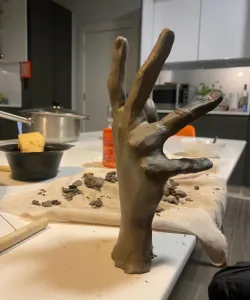
Can I bum a smoke? was one of my first sculptures I made, created at the Hartstown Community School, just outside of Dublin during my Dual BA there. For my friend and I, taking a ceramics course there meant a three-hour commute, but every minute was worth it. Spending time sculpting with her made me think of how much I appreciate the friends I made in Ireland, who this sculpture is dedicated to. Originally, I had just made a model of my hand as anatomy practice, but when the pinkie popped off during firing, I decided to embrace the mistake. The popped-off pinkie became the centerpiece, showing how a part of our body is consumed as we smoke.
I think that the Arts & Research Collective can play the role of an interest-based group to promote student work and also create connections between students with similar interests. It would be great if there were more events hosted for participating or interested students to meet each other and learn about each others’ work. Likewise, if students have demonstrated an interest in galleries or art, it would be amazing if Arts & Research Collective could offer tickets to gallery openings or leverage our position within New York and Columbia. I think the Collective can play a role in creating a community of otherwise disparate people.”
Fernando Luis Zapata ‘25GS
Undergraduate, film and media studies major
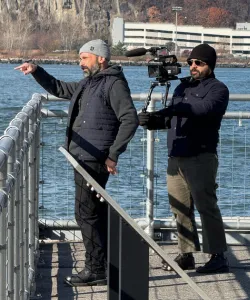
“I first learned about the Collective by seeing all the great fine art and photography that hung in the GS lounge throughout my time at Columbia. Seeing all the great artwork coming from fellow GS’ers really motivated me to submit my own films. Knowing that these works were born from non-traditional students with very varied life experiences was both illuminating and thought-provoking. I hoped that my work could be seen alongside and in conversation with these artists.
Studying Film and Media Studies at Columbia University has provided me with a vast amount of knowledge on the power of filmic language and its ability to communicate complex human experiences. As an older undergraduate student and military veteran, I understand that many of these human experiences are frequently filled with internal struggles, moral questions and the search for a fundamental understanding of what is right and what is wrong. These questions can become magnified into powerful, yet opposing forces that can sit upon each of our shoulders as we endeavor to reconcile their piercing disharmony.
Clearly, such subject matter is very weighty and leads to deep introspection and thought. Traditionally, a filmmaker would likely tackle such a concept through a close, portrait-centered feature-length work. However, I felt that the ‘affectiveness’ of filmic language could still fulsomely convey the interiority of a person dealing with the struggles of right and wrong, vengeance and forgiveness. Invigorated by the challenge of the 5-minute format, I proceeded with the production of CLOSURE.
Filmed in just over four hours of shooting, CLOSURE presents the mind of a woman who must suddenly deal with her difficult familial past. Brilliantly portrayed by fellow Columbia student Rose Hollingsworth, ‘Alicia’ is a character tortured by estrangement and violent loss, and when presented with limited time, she must do something she has avoided for most of her life. Alicia must finally resolve her painful feelings of anger and longing...she must finally find closure.
DIFFIDENCE —’modesty or shyness resulting from a lack of self-confidence’—was made as part of the Visual Arts Department Intro to the Moving Image & Video course. This narrative short film tackles the seemingly endless power of doubt in our lives. Shot on the streets of New York City, the film’s story centers around a screenwriter who must simultaneously work against the obstacles found in the creative arts and the obstacles found within himself. After all, there can be no success without first dealing with our greatest threat, our own diffidence.
I think the Collective should continue to seek out and exhibit the many artistic works of GS creatives. GS students come to Columbia from fascinating life experiences, and their artistic expressions reflect these varied histories. Having such multilayered sources of artistic expression can provide a very rich and meaningful impact on the entire Columbia student body. I think larger future exhibitions would be of great benefit to all.”
Melanie Yiyin Zhang ‘26GS
Undergraduate, religion major
“I learned about the Arts & Research Collective through GS emails and GS Academic Affairs emails. I was excited by the opportunity to share my research in a creative and interdisciplinary space that bridges arts and scholarship.
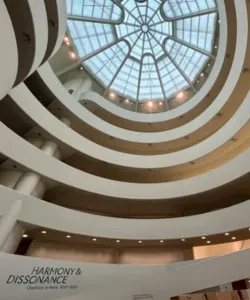
The first piece is "Architecting the Sacred Space at the Guggenheim." I argue that Guggenheim's spiral and non-orthogonal galleries produced a sacred, contemplative experience independent of the artworks. Using close observation during the Piet Mondrian show. I track how architectural interruptions force viewers to re-orient their bodies and attention. Framed through Stephen Greenblatt's "wonder" and Pamela Smart's "aura," I show how disorientation heightens focus and sustains contemplations; belief, guided "wow" moments on the architecture tour evidence Durkheim's collective effervescence. The museum architecture can ritualize looking, turning circulation into a shared quasi-liturgical experience.
My Second piece is "Kukai's Vision in a Time of Crisis." This essay reinterprets Kukai's statecraft in early Heian Japan: how he secured imperial patronage while critiquing COnfucian ritsuryo ideology and Nara scholastic Buddhism. Combining close reading of Sango Shiiki with court history of famine, disasters, legitimacy crisis, I show how Kukai recoded esoteric ritual as national protection, founded institutions, and translated Buddhist ethics into the court's moral register. His strategy of subordinated inclusion positions Confucianism and exoteric Buddhism as necessary but incomplete steps toward esoteric fulfillment. Audiences see Kukai not only as a doctrinal innovator, but as a rhetorical and institutional architect of religious solutions to political crises.
I think the Collective provides a great platform for GS students to share the research in creative and interdisciplinary ways. I think the Collective should serve as a hub where GS students can showcase their work and build a visible research community. I hope the Collective continues to host events that invite students, faculty, and the broader GS community to come together, exchange ideas, and learn from one another. In the future, I hope to see the Collective create a website collective that showcases the Collective to more people. When my professors ask for the Collective, it would be great if I could provide links to them.”
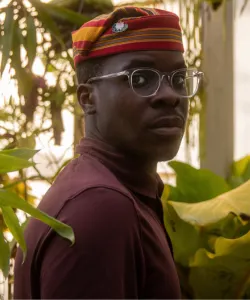
Mikka Kabugo ‘25GS
Undergraduate, Art history and economics majors
“Being part of the Collective is very much now like a purpose on its own. The Collective is very localized and that means so much to me. I have had people who’ve mentioned to me how many memories and friends they’ve made on the backdrop of the works in the Collective and, for them to have it as part of their lives in that way makes the work even more alive and enjoyable. It’s an honor for me to be a part of people’s GS experience in that way.
The work I submitted to the Collective was /Studio Akkim 514/. It took me well over 9 months to finish because it was fundamentally an abstract of my experiences as an individual. It was also the work that defined my senior thesis and allowed me to conceptually construct a self portrait. I really can’t say what audiences should take from it, there are so many aspects of the work, it is in many ways an academic journey into my creative process and lived experiences.
The Collective allows for GS students to show their plethora of talents and gives us an opportunity to contribute to a creative community amongst each other. Every year, the Collective gets bigger, more creative and innovative and is a sign that GS students are inspired. In years to come, I see the Collective as a hallmark of GS creative culture.”