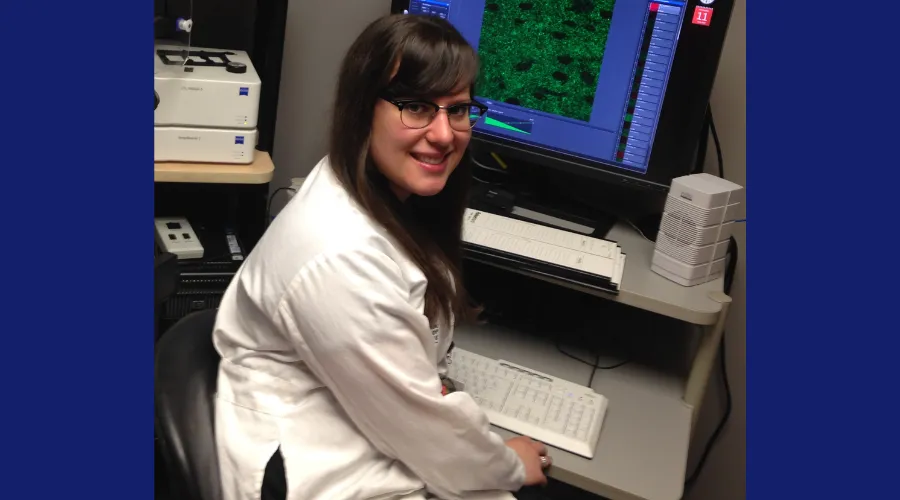
From a young age, Sarah DeMoya thought she was headed to medical school.
“I had a book called Germs Make Me Sick, about viruses and bacteria. I used to read it when I was five years old and ask my friends what germs they had,” said DeMoya.
Then, as a student at Brigham Young University, DeMoya stumbled upon a neuroscience class. “I was hooked,” she said. “I thought it was so cool how the activity of cells leads to behavior.”
Discovering neuroscience put DeMoya in a different direction, where she would zoom in on some of the brain’s tiniest parts to further our understanding of memory.
DeMoya worked at Brigham Young’s Memory and Decision Making Lab as an undergraduate volunteer, then continued in the same lab to earn a master’s degree. She studied long-term memory, looking at how changes in the activity of specific brain regions correlate with memory performance. When she began her PhD at the Icahn School of Medicine at Mount Sinai, she dialed in her focus to study memory at the cellular level. DeMoya observed how the tiny dendritic spines that connect neurons are lost as brains age. She showed that the loss of a specific kind of dendritic spine—thin, flexible ones—in the parietal cortex is associated with working memory impairments in aging.
While doing this research, DeMoya also took the time to reach out to other women breaking into science. She became the founding president of Women in Science at Mount Sinai and New York Women in STEM, an inter- institutional organization that advocates for women in the early stages of their scientific careers across the New York City area.
In 2018, DeMoya came to Columbia as a postdoctoral research scientist and continued her work with dendritic spines. She discovered that when brains lose these spines, the surviving ones tend to be found in clusters, which aids in the preservation of memory function.
In hindsight, DeMoya reflects on how her undergrad experience helped her find her true path, and she enjoys encouraging her current students on their own journeys. Now a lecturer in discipline in Columbia’s psychology department and a director of undergraduate studies for the neuroscience and behavior major, she is opening the laboratory doors to even more students.
With collaborators at Columbia’s Zuckerman Institute, a grant from the Office of the Provost, and in-kind support from the Center for Teaching and Learning, DeMoya developed the class Neuroscience Methods: Cells and Circuits, in which undergraduates learn skills involved in neuroscience research.
Now in the class’s second year, DeMoya has noticed a trend: About half the students come from the School of General Studies, which makes up a third of Columbia’s students overall.
DeMoya thinks this is because GS students tend to proactively seek out what they need to reach their goals. “They are so enthusiastic,” she said. “They say, ‘I want to learn more. I want hands-on experience.’ They want to get into labs, and they see this class as a way to help them get there.”