
At 50, This “Non-Nontraditional Student” is Finding His Place at Columbia
After a three-decade gap, Michael King ‘28GS arrived at Columbia GS certain of his path forward, only to find that the opportunities he would discover were bigger than he’d imagined.
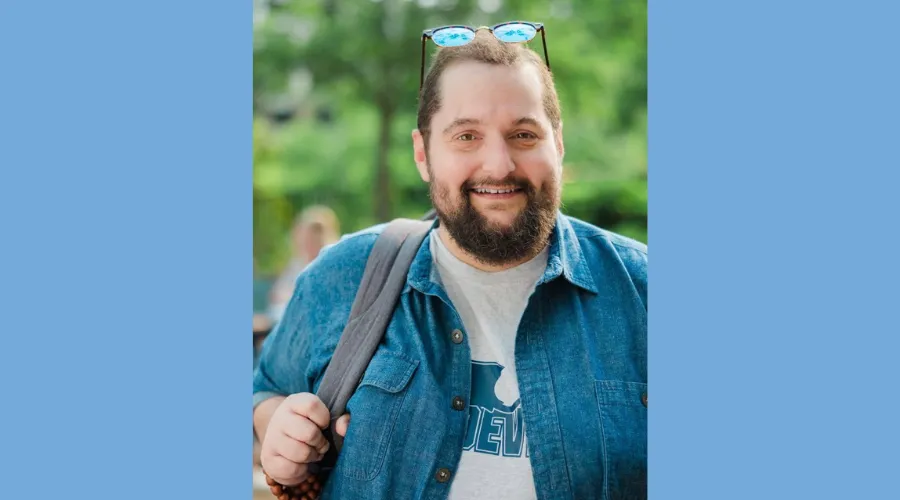
When Michael King ‘28GS arrived at Columbia, he thought he knew exactly what he wanted.
He’d returned to school after a three-decade gap, earned an adult high school diploma, enrolled and excelled at Cape Fear Community College, and received a prestigious scholarship. King’s life had begun to point him in a specific direction: he wanted to study psychology and work as a substance-use counsellor.
Then he got to GS. And after stumbling into a class with a broken leg, being personally invited into a seminar by his dean, and becoming increasingly involved in student life, he realized he had more opportunities than he could’ve previously imagined.
“I always thought that was something the younger students would go through—they make up their mind when they get here—and I was like, that was the advantage I have of being an adult; I know what I want. And then when I got here…I was wrong in the best way possible.”
At 50, King describes himself as a “non-nontraditional student.”
After 30 years of struggling with severe alcohol use disorder, he was required to undergo professional substance use counselling to qualify for a liver transplant. In those sessions, his psychologist saw something in him and in the way he was able to listen, learn and converse with his group members. She told him he would make a good peer support specialist. It was this encouragement that led him to obtain his adult high school degree at Cape Fear Community College (CFCC), and later to apply for a Pell Grant and enroll for a substance use counseling associate’s degree.
At CFCC, King found his place in the student community. He was invited to join Phi Theta Kappa (PTK), the national honors society for two-year colleges, and soon became the vice president of scholarship and an officer with the Student Government Association. It was during this time at PTK that Columbia sent him a blind email inviting him to apply and to tour campus with an academic advisor.
Travelling to New York from North Carolina for a day simply didn’t seem feasible—but he made it happen. As one of 90 students selected to volunteer for the American Psychological Association Conference in D.C., he took a day off and took a train up to see campus. “What was supposed to be a 30-minute conversation turned into almost 3 hours,” King recalled. Shortly thereafter, he was given the Dean’s referral for his Columbia application.
While King was initially planning to apply in a year, a sudden change in his community college’s work-study funds left him and other students without employment in the Spring. Unsure of how to navigate tuition, he decided to speed up his timeline and apply to GS immediately. With three days to prepare an application, King put together his essay, found recommenders, and submitted the application that would bring him to GS with 10 minutes to spare.
He applied to the Jack Kent Cooke Foundation for the Undergraduate Transfer Scholarship, one of the most prestigious and selective scholarships to support high-achieving community college students as they study. Through determination and grit, and after many ups and downs, he received a full ride. He was coming to Columbia.
“I almost lost my voice. I screamed so loud, I drove immediately to where my mom works, tears in my eyes, holding my letter up,” King said. “I then drove straight to Best Buy and bought a big pack of the fancy linen style paper, and was printing out copies of my acceptance letter, because the very next day I was volunteering for our community college's graduation ceremony. Our Phi Theta Kappa chapter was selling flowers—and I was handing out copies of my acceptance letter like breath mints.”

While the transition to Columbia is intimidating to many, King found himself immediately at home. “GS kind of acts as a big family,” he said. “Doesn’t matter what time I walk into Lewisohn Lounge, there’s always someone I know there.” GS students come from vastly different backgrounds, spanning their 20s through their 50s, which helps. “We're all taking the same classes, so we can relate to each other a lot more.” Academically, he has been just as fortunate, finding himself in classes that most students have on their bucket lists and often have to wait a few semesters to take.
Columbia’s famous Game of Thrones class with Professor Hamid Dabashi is one such example. At the New Students Orientation Program (NSOP) Mets game, he injured his leg and ended up on crutches for the first few weeks. Scrambling to find an alternative for a class that he missed when he was in the hospital, he hobbled into the lecture hall while number 200 on the waitlist, and was accepted in 5 minutes. “You walked here on crutches just to ask me if you can get in class?” asked his professor. “You’re good.”
At the student-faculty dinner, as he sat at the bar eating pizza alone while waiting for his professor, Dean Rosen-Metsch approached him and invited him to join the class for Philanthropy and Just Societies. “It's nice to see the pressure starts from the top and works its way down,” he joked, after getting his approval at 3 a.m. “[In] my first two semesters, I've been in two of the most difficult classes to get into on campus. I seem to be the student that's always in the class that everybody's talking about.”
To him, these stories sum up the GS experience. “Every time someone needs something… everyone says yes. Everyone says, let's see how we can do this. Let's see how we can help you make this happen.”
Having benefitted from this culture of giving, King has been giving back in his own way. He was a crew captain at NSOP this fall, and has continued mentoring students as they write their applications for scholarships and school. Outside of class, he loves cooking for his friends, and has recently whipped up fried chicken, mocha and peach ice cream, and pineapple sorbet cheesecake. In balancing academics and the demands of daily life in New York City, King encourages others to “take time to have fun. Class can become overwhelming if you don't take care of yourself, and having fun is part of those things that will help you manage your wellness.”
Although he had been completely focused on a future in substance use counseling when he arrived at GS, his experiences at the school have opened up many more opportunities. “I kind of find myself at a crossroads,” he said. He might pursue a master's in psychology, or apply to SIPA, or build on his class here and look toward grant writing. He hasn’t decided, and for now, that’s fine by him.
His advice to others is the result of a tumultuous journey of self-discovery and persistence: “You are your own best advocate; no one’s going to tell your story better than you are.”