
When the Detour Became the Direction: Mikka Kabugo ‘26GS on the Strength of a Nontraditional Path
Through work in entrepreneurship, finance, and the arts, Mikka Kabugo ‘26GS shares how a nonlinear path can lead to some of life’s greatest moments both in and out of the classroom.
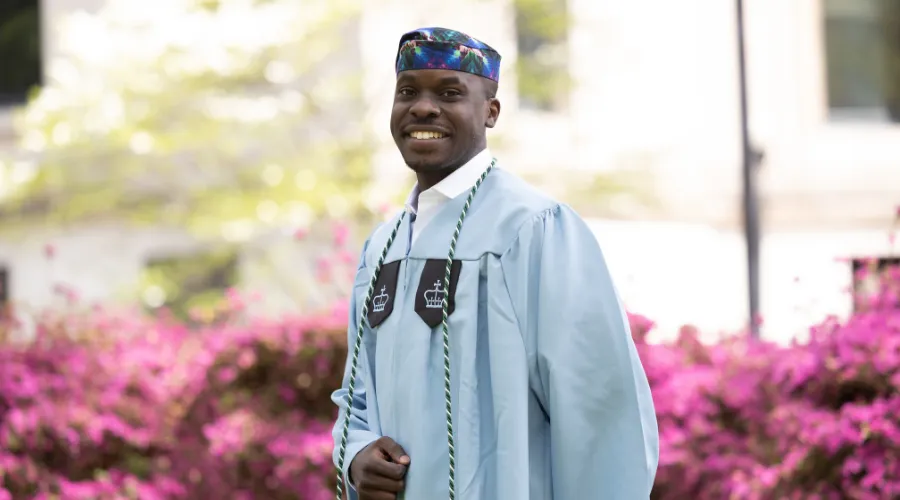
Like many of his fellow GSers, the path that Mikka Kabugo ‘26GS took to Columbia didn’t follow a straight line—it began in medical school in Beijing. Immersed in a rapidly shifting global landscape, Kabugo moved from studying medicine to exploring the intersections of economics, policy, and cross-border markets, even co-founding a consulting group. Along the way, art remained a constant, shaping how he understood identity, systems, and the spaces in between. From surrounding himself with others who’ve followed nontraditional paths to making sure he always reads his GS emails, Kabugo reflects on how his winding path to Columbia wasn’t a detour; but the one he was meant to be on all along.
Tell us about your path to GS:
My path to GS started at a medical school in Beijing.
I enrolled at Peking University Health Science Center, and I was on track to become a doctor. What I became instead was fluent in Mandarin and deeply curious about how economies and policy function. Living in Beijing was transformative, not because of what I studied in the classroom, but because of what I encountered outside it.
I watched Chinese investors look toward Africa and African entrepreneurs look toward China, and noticed that very little infrastructure existed to connect the two outside lateral governmental frameworks. So I helped build one. I co-founded Kente & Silk, a consultancy working at the intersection of Africa–China business relations. That meant navigating fragmented payment systems, limited logistics networks, and the institutional gaps that make cross-border work so difficult, and it was my first real education in how markets, capital, and policy function when something actually needs to get done.
Through all of this, I was making art. I've made portraits for as long as I can remember. Exploring questions about identity, memory, and representation that my academic life hadn't yet given me a language for. Art was a constant thread.
When COVID disrupted my studies, I faced the question directly. I could keep pushing down the medical path, or I could move toward the work that was already pulling me: economics, finance, policy, and the visual and cultural questions I'd been circling through my art. I chose the latter.
However, I needed a place that wouldn't ask me to flatten that range into a single track. I needed rigorous economics and finance. I needed art history and studio practice taken seriously alongside them. I needed to be around people whose paths were as nonlinear as mine—people who'd understand that the detours weren't detours at all.
That place was GS.
"If there's one thing that defined my time at GS, it's that I never had to choose between the different parts of who I am"
What has been your proudest moment/greatest accomplishment at Columbia?:
My proudest accomplishment at Columbia has been building work that connects ideas to real impact not as an abstraction, but as a practice. The clearest example is my time at the New York State Department of Financial Services. I contributed to mapping underserved communities and analyzing gaps in banking access across New York State—work that made visible how financial infrastructure shapes people's ability to participate in the economy. It brought together everything I'd been studying in economics, policy, and markets, but with real consequences attached. That was a turning point. I wasn't just learning how systems work; I was contributing to efforts to change them.
But the experience that shaped me most deeply was my three years volunteering with Columbia's Justice in Education Program on Rikers Island. Every Saturday morning, which meant no Friday nights out—I'd go in and teach. The work centered on art-making, art history, and financial literacy: how to build a life on the outside, how to think about money and credit and planning in concrete terms. What stayed with me most, though, was the art. We'd have few colors and a blank surface, and from that, people would create entire cityscapes. The idea that you can have so little and still make so much became a kind of thesis for how I think about education itself. Our program director, Mia Ruyter, modeled that conviction every week, and it shaped how I understand what teaching and access can actually do.
Those two experiences, one inside state government, one inside a jail, converged into what became The FinLit Café: a financial literacy platform I've been developing that targets what I think of as "credit insecurity," the gap between having access to financial products and actually understanding how to use them. DFS showed me the systemic picture. Rikers showed me the human one. The FinLit Café is my response to both; a structured, grant-ready model grounded in policy research and aligned with institutions like CDFIs, designed to be practical, scalable, and rooted in real need.
Alongside all of this, I've worked to build within the Columbia community itself, through student government and campus initiatives focused on improving transparency and access for students navigating nontraditional paths. Being part of shaping that experience for others, not just benefiting from it, has mattered to me as much as any single project.
Tell us about a class, group, or professor/person at Columbia that was instrumental to you during your time at GS:
If there's one thing that defined my time at GS, it's that I never had to choose between the different parts of who I am, and that's because specific people made sure I didn't have to.
Dean Kristy Barbacane, my academic advisor, set the tone early. She was the one who introduced me to the precursor of the GS Arts & Research Collective during my first semester. That mattered more than I realized at the time. It gave me a community where interdisciplinary thinking wasn't just tolerated but expected, and it gave me permission to treat the range of my interests as a foundation to build on rather than a problem to resolve.
Economics Professor Susan Elmes pushed that further. At a moment when I was weighing whether to commit fully to economics or stay close to my art practice, she didn't let me frame it as a binary. She encouraged me to pursue economics rigorously, and to keep making art work, to understand that my strength was precisely in the place where analytical thinking and creative inquiry meet. That reframing changed how I structured the rest of my time at Columbia.
Dr. Mia Ruyter and the Justice in Education Initiative grounded everything in purpose. Through three years of Saturday mornings on Rikers Island, I came to understand the human weight of the systems I was studying in the classroom: policy, access, structural inequality. That experience didn't just inform my academics; it gave them urgency.
And then there's art history Professor Alexander Alberro, whom I first met at Columbia’s summer in Venice. Studying with him reshaped how I think about art's place in the world. His teaching made clear that art history isn't a rearview mirror, it's a way of understanding how identities form, how power operates, and how cultural narratives get constructed and contested. That framework gave me a vocabulary for my own practice as an artist that I hadn't had before.
Together, these mentors allowed me to build an education that holds markets, culture, and human experience in the same frame, not as competing interests, but as parts of the same inquiry.
"That's what I'd want incoming students to understand, and honestly, what I want to remind myself of as I move forward. The nontraditional path isn't a detour; it's education"
What advice would you give to a student who's about to start their GS journey?:
First—read your emails. It sounds almost too basic to say out loud, but nearly every opportunity I've had at Columbia started with an email. Programs, internships, events, research positions; they are constantly being shared, and it's easy to let them scroll past. GS gives you access to an incredible ecosystem, but you have to meet it halfway. Staying attentive to what's coming through your inbox is one of the most practical things you can do.
Second—recognize the people around you. GS does not make mistakes in who they admit. Every student I've met brings something distinct, whether it's professional experience, resilience, perspective, or creativity. If you take the time to actually see that in the people sitting next to you, it will transform your experience. The community becomes not just a network but a genuine source of insight and support.
What I've learned is that your time at GS is shaped by how you engage with information, with people, and with the opportunities right in front of you. Stay curious, stay intentional, and the school will give you far more than you expect.
What are your plans for after graduation?:
I plan to bring together everything I've built at Columbia across finance, policy, and the arts—into work that lets me keep learning while actually building something.
I'm drawn to consulting and startup environments: spaces that are dynamic, problem-oriented, and reward the kind of cross-disciplinary thinking GS trained me in. Whether that means working at the intersection of markets and culture, helping organizations think about access and equity, or something I haven't encountered yet, I want to be in rooms where I can grow quickly, take on real responsibility, and contribute meaningfully. I work best when I'm close to the problem, not theorizing from a distance, but helping figure out what needs to get done.
At the same time, my artistic practice will continue. That work has always run alongside everything else, and I don't see that changing. Further ahead, I've considered graduate school, but I see that as a step that should come after a few years of industry experience. I want to enter that next chapter with sharper questions, informed by practical exposure and a clearer understanding of where I can have the greatest impact.
Is there anything else about your GS story that you’d like to share?:
I arrived at Columbia with fragmented experiences but no single story that tied it all together: medicine in Beijing, a business bridging Africa and China, an art practice I'd carried with me across continents, and a growing conviction that economics and policy were what I needed to feel complete.
For a long time, I thought the challenge was choosing which of those threads to follow. What GS showed me is that I didn't have to get lost in the thought of choosing. The challenge was learning how to build something coherent from the full range of what I'd lived.
That's what I'd want incoming students to understand, and honestly, what I want to remind myself of as I move forward. The nontraditional path isn't a detour; it's education. Every Saturday morning on Rikers, every late night in the studio, every problem set in industrial organization, every conversation with a mentor who saw connections I hadn't yet drawn, all of it counts.