
A Short History of Columbia’s School of General Studies
Historian Robert A. McCaughey, a longtime Barnard College professor and distinguished scholar of American intellectual life, shares his deep knowledge of—and great passion for— the School of General Studies.
More so than the other 18 schools that make up the 267-year-old Columbia University, including its newest, the Columbia Climate School, the 75-year-old School of General Studies is mostly a history of student striving and accomplishment by alumni. To be sure, the school’s administrative history matters, as has the scholarly productivity of the men and women who have constituted its faculty, but neither its estimable deans nor its talented professors account for the unique place GS holds within the University and more broadly within American higher education. The Columbia historian Richard Hofstadter concluded his history of the American antebellum college quoting a president of Williams College in 1873: “Professors are sometimes spoken of as working for the college. They are the college.” Students are sometimes spoken of as attending the School of General Studies. They are the school.
For this reason, when Dean Lisa Rosen-Metsch first raised a year or so ago the prospect of my writing a history of the School of General Studies, I welcomed the opportunity. Having already written Stand, Columbia: A History of Columbia University in the City of New York (2003); A Lever Long Enough: A History of Columbia’s School of Engineering and Applied Science (2014); and A College of Her Own: The History of Barnard College (2020), I looked forward to another bite at the apple, not least because of my five-decade-long fascination as a faculty member and dean at Barnard College with GS, its history, its leaders, and its students.
This newest undertaking, however, hit the two in-residence members of the McCaughey household differently. My wife, having tolerated three decades of dinnertime conversation about arcane aspects of Columbiana, shuddered at what might follow next. Untold tales of the Mailman School of Public Health? The definitive history of the second-floor broom closet of the Columbia Law School? Thus arises the need to assure her—and the readers of The Owl—that I see the intellectual challenge here less seeking a proper balance between criticism and commendation of an institution’s past than containing my unabashed excitement about the School of General Studies’ present condition and future prospects.
The Early Years
The forerunner of the School of General Studies, University Extension joined the proliferating list of Columbia’s schools and programs in 1904. The brainchild of Nicholas Murray Butler, it encapsulated the new president’s “bigger is better” outlook. He regularly described the activities University Extension oversaw—summer session, Home Study, the Institute of Arts and Sciences offering lectures to the general public, a writing program, courses in business—as the University’s “obligation to the community,” but what really endeared these ventures to him were their enrollments. World War I provided still more opportunities for UE to increase its numbers, including courses in “English for Foreigners.” But with the Armistice came misgivings about “bigger is better.” Skeptics included successive deans of Columbia College: Frederick Keppel (1912-1918) and Herbert Hawkes (1918-1943), who opposed enlarging Columbia College if it meant relying upon the mostly Jewish graduates of the city’s public high schools. Hawkes persuaded the Columbia trustees in 1921 to set a cap of 550 for entering classes to the College, allowing admissions officials over the next two decades to reject hundreds of otherwise qualified applicants.
Even as Extension enrollments grew in the 1920s (peaking at 19,000 in 1926), Butler had his own second thoughts about a major research university so heavily invested in adult education. These concerns heightened in 1930 when UE’s Home Study offerings in household economics drew the satirical attention of the prominent university consultant Abraham Flexner. Rather than respond personally, Butler left his longtime UE Director James Egbert to do so. In 1942, after a decade of declining extension enrollments, Egbert retired as director. His successor, Harry Morgan Ayres, an English professor approaching retirement, understood his role to effect University Extension’s liquidation.
Unto the Breach
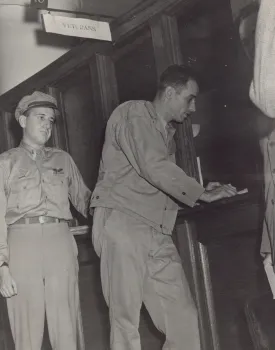
The pressing question for Columbia as World War II ended was how to accommodate its share of the anticipated two million returning veterans seeking further formal education with the least disruptive impact on Columbia College. Patriotism and generous GI Bill funding mandated the first concern, while the second produced the reprieve of a renamed University Extension. In December 1946 the Columbia trustees created the School of General Studies, to open the following July. Its mission: to provide the educational opportunities sought by federally funded veterans who would enroll at Columbia between 1946 and 1949 (some 10,000 in all), while allowing its 2,000-student maleonly Columbia College, except for dropping its discriminatory policies, to carry on status quo ante bellum. This hastily implemented plan had General Studies and the College operating as separate entities with minimal contact between their students, who already differed in admission age (16 for the College, 21 for GS), gender exclusivity (GS was open to women), and breadth of life experiences, but were further segregated by the timing of classes, separate teaching staffs, different major requirements, and access to the extracurriculum. The College insisted upon two other distinctions: that its celebrated core curriculum be off limits to GS students and that graduates of the College receive the BA degree, with GS graduates limited to the down-market BS.
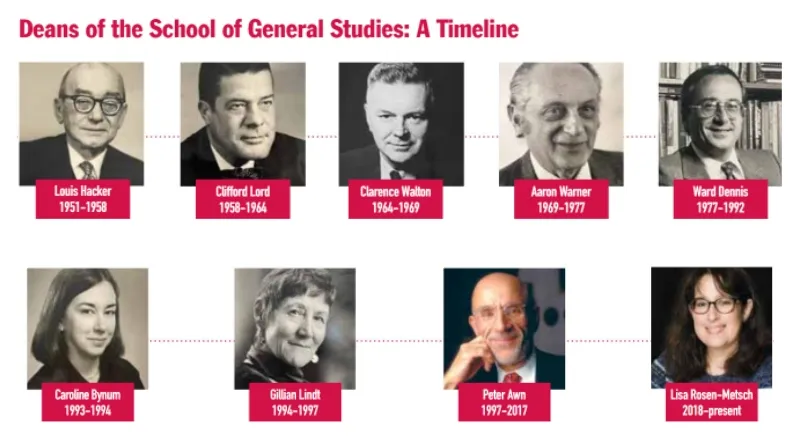
The appointment in 1951 of the economist Louis Hacker as the first dean of the School of General Studies and the retirement of the accommodating Harry Carman as dean of Columbia College (1943-1950) brought an end to the short honeymoon between the College and GS. Hacker moved aggressively to sustain General Studies in anticipation of a declining veteran population. Among his lasting initiatives was creating a novel dualdegree program in 1954 with the Jewish Theological Seminary and a year later the nation’s first postbaccalaureate premedical program. Hacker joined GS students in calling upon the College for greater access to the extra-curriculum and upon the trustees for its graduates to receive the BA degree.
Such moves were seen by successive deans of Columbia College and Columbia Spectator as GS “expanding into educational realms not properly within its scope.” Meanwhile, GS’s growth—in 1954, at 9,000 enrollments, the largest of the university’s 15 schools—prompted Spectator editors to ask rhetorically: “Is General Studies offering an easy way to a Columbia degree?” (Some canards never die!)
In 1955 Provost Jacques Barzun ’32CC persuaded President Grayson Kirk to convene a Commission on the Future of the University. The ensuing “Macmahon Report (1957),” self-congratulatory as regarded Columbia’s overall standing, saved its criticisms for the School of General Studies, all but calling for its closure. Despite assurances from Kirk that the report’s punitive recommendations as to GS would not be implemented, Hacker resigned as dean and left Columbia. What followed was a decade when GS’s second and third deans, Clifford Lord (1958-1964) and Clarence Walton (1964-1969), carefully avoided the boundary disputes of their combative predecessor, while neither secured a recognized place for their school and its nontraditional students in an increasingly beset Columbia University.
Hanging In—GS and the University’s Time of Troubles
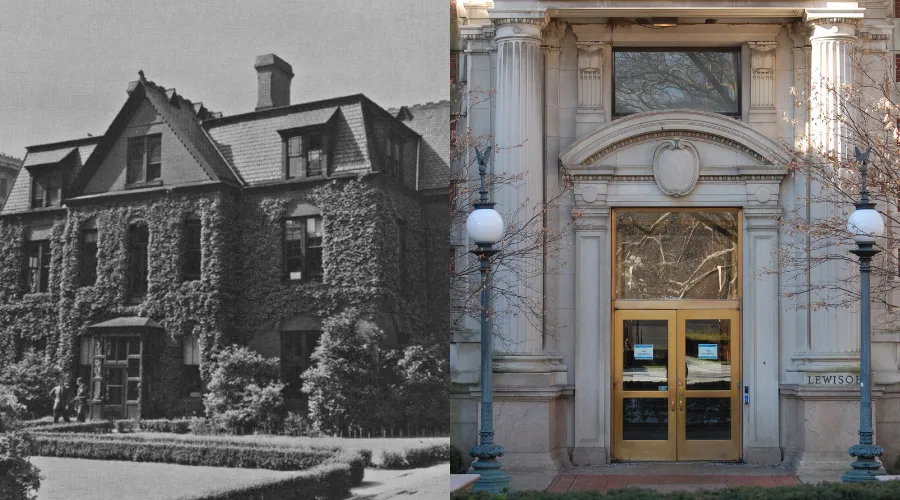
Clarence Walton’s last substantive action as GS’s third dean, in the company of GS students protective of their school, was in the tumultuous spring of 1968 keeping College protesters from occupying Lewisohn Hall, the new home of GS. Shortly thereafter, William McGill became Columbia’s 15th president and put the University through a painful but lifesaving decade of austerity. Complaints continued from successive deans of Columbia College that GS deprived the College of needed resources, to which successive GS deans argued that its operating surpluses helped keep the University afloat. Only under the leadership of McGill’s successor, Michael I. Sovern, would Columbia’s finances be stabilized, but with the fate of GS still uncertain. Meanwhile, Deans Aaron Warner (1969-1977) and Ward Dennis (1977-1992) proceeded cautiously and avoided the direct fire of College loyalists, who beginning in the early 1970s focused more on making the College coeducational, an undertaking that put them less at cross purposes with GS than with the affiliated and women-only Barnard College.
In December 1946 the Columbia trustees created the School of General Studies, to open the following July. Its mission: to provide the educational opportunities sought by federally funded veterans who would enroll at Columbia between 1946 and 1949 (some 10,000 in all).
The political machinations of the 1970s and ’80s should not obscure two concurrent developments that enhanced GS’s survival prospects. The first was the growth of a substantial and loyal body of GS alumni, proud of their Columbia degrees and of their GS experience. By 1990 they numbered 10,000 and included men and women of financial means and personal character to make their loyalties known to the University’s administrative leadership and trustees. A second contingent of GS advocates consisted of Columbia (and Barnard) faculty, some acting from a principled belief in the necessity of a university serving more than the traditional age-bounded and educationally privileged segment and extending those opportunities to a much larger constituency of adults in search of educational enrichment and commensurate credentialing. Other faculty came by their proGS persuasion from their experiences in the classroom, where they found GS students provided a value-added component to the discussions. These faculty included several women whose departments in the 1960s and 1970s limited their teaching to GS. In Columbia’s 18th president, George E. Rupp (1993-2002), who saw the strengthening of the undergraduate experience at Columbia as his primary goal, GS alumni and pro-GS faculty found a kindred spirit.
New Beginning
Rupp started his presidency in the spring of 1993 with a major organizational reordering of the way Columbia administered undergraduate education. He fired both the dean of the Graduate School of Arts and Sciences and the dean of Columbia College and filled the position of dean of General Studies, which had been vacant since the death of Ward Dennis a year earlier. He then merged the jobs of vice president for arts and sciences and dean of the College, to which Steven Marcus was appointed, and named Caroline Bynum dean of General Studies and the newly created vice president for undergraduate education. Neither Marcus nor Bynum remained in these positions for long—Marcus for two years and Bynum for one—and the attempted shakeup was deemed at the time a failure. In retrospect, the appointment of Bynum, a distinguished medieval historian and scholar of religion, was a new beginning for the School of General Studies, one marked by presidential approbation that has since persisted.
Awn played the long game. This meant bringing the educational opportunities of GS students into closer alignment with those of the College (and Barnard), including access to heretofore off-limits core courses, even as he celebrated the social and experiential heterogeneity of GS’s nontraditional students.
Bynum’s year as dean prepared the way for more clearly separating the undergraduate component of General Studies from its other educational functions. The actual reorganization occurred in July 1994 during the succeeding deanship of Gillian Lindt, with the School of General Studies retaining responsibility for the undergraduate program and the postbaccalaureate premedical program, while assigning special programs, summer session, and nondegree offerings to the School of Continuing Education, with Frank Wolf as dean. A Rupp-commissioned Task Force on Strategic Planning in 1994 presented an upbeat assessment of the future prospects of GS, the animosity of the Macmahon Report a quarter-century back now all but forgotten.
Lindt’s deanship (1994-1997) was also brief but again had administrative responsibility for the School in the confident hands of a distinguished scholar who had the respect of the University’s other deans and the president’s personal backing. By the end of Lindt’s three-year term, the School of General Studies had come to be widely (if not yet universally) accepted alongside the College and SEAS as one of Columbia’s three coequal undergraduate programs, with Barnard College an affiliated and contributing fourth.
Yet it was Rupp’s appointment in 1997 of Peter Awn, an ex-Jesuit priest and specialist in Islam, that provided the sustained and charismatic administrative leadership needed to propel the School of General Studies to be one of the signal success stories of 21st century Columbia.
A School in Full
Awn played the long game. This meant bringing the educational opportunities of GS students into closer alignment with those of the College (and Barnard), including access to heretofore off-limits core courses, even as he celebrated the social and experiential heterogeneity of GS’s nontraditional students. This required stabilizing the School’s mercurial financial fortunes, improving the persistence of students through to graduation, and keeping pace with the annual tuition increases in the College. This last he called the price to be paid for an education that matched that of the College, while urging the central administration and GS alumni to provide additional financial aid support.
Success in securing GS students greater access to extracurricular activities resulted in their serving on the editorial board of the Columbia Spectator, representing GS on the undergraduate Committee on Instruction, and assuming leadership roles in campuswide organizations. GS students also became prominently involved in early organizational efforts by the University’s LGBTQ+ students and their supporters.
In 2005 Awn and his team produced “Past History, Current Reality & Plan for the Next Decade (2005-2015)” for President Lee Bollinger’s consideration. It called for the steady expansion of GS enrollments from 1,700 full-time equivalent students in 2005 to 2,700 in 2015, along with a greatly increased recruitment effort directed at military veterans and graduates of the nation’s leading community colleges. It also involved expanding GS’s pioneering dual-degree undergraduate programs with universities abroad. After reviewing the plan, Bollinger authorized its quiet implementation.
The outreach to veterans marked a departure from the anti-war protests of the 1960s and Columbia’s abrupt decision in 1968 to terminate its 22-year NROTC program.
The outreach to veterans marked a departure from the anti-war protests of the 1960s and Columbia’s abrupt decision in 1968 to terminate its 22-year NROTC program. It also clashed with contemporary campus sentiment when in 2005 the University Senate overwhelmingly rejected a resolution calling for the restoration of ROTC. In accepting the vote, Bollinger allowed that Columbia might be open to a return of ROTC if and when Congress jettisoned the Clinton-era “Don’t Ask, Don’t Tell” policy that prohibited gays from openly serving in the military. In 2008, at the urging of GS veterans, Columbia’s trustees approved the University’s participation in the Yellow Ribbon Program, in which post-9/11 veterans attending universities where the tuition exceeded the amount for which these veterans were eligible had half the difference covered by the admitting university. Upon the rejection of DADT by Congress in 2011, Bollinger quickly secured an agreement with the Department of the Navy to provide Columbia students access to ROTC.
By then Bollinger and his inherited GS dean had become fast friends, a relationship the president acknowledged in 2017 accepting Awn’s decision to step down and more movingly at Awn’s memorial service in February 2019, after Awn had been fatally injured by an automobile while crossing 116th Street.
This heartbreak is especially palpable for the General Studies community where, during his 20-year tenure, Awn came to personify the School’s character, values, and mission. For him, that meant a student body composed heavily of student veterans, first-generation students, and international students, whose age and life would further diversify and enrich our undergraduate classrooms.
In calling Awn “without question, one of the essential leaders of Columbia University’s modern era,” Bollinger cited as evidence his embracing the school’s long-held relationship with the Jewish Theological Seminary. A year earlier he had selected as GS’s current dean Lisa Rosen-Metsch ’90, a graduate of the Joint Degree Program between GS and List College of the Jewish Theological Seminary. The daughter of Brooklyn public school teachers and an expert in the treatment and prevention of HIV/AIDS among populations with substance-abuse disorders, RosenMetsch joined the Mailman School of Public Health in 2012. Hers is the formidable task of sustaining the momentum achieved by her predecessors, no longer finding a secure place in the University for GS but making manifest to the entire Columbia community what Bollinger has recently called “the genius of General Studies.” Abetted by an energized alumni body, a supportive faculty, and a diverse and multitalented student body, and on the occasion of the School’s 75th anniversary, she and her colleagues have every prospect of succeeding.