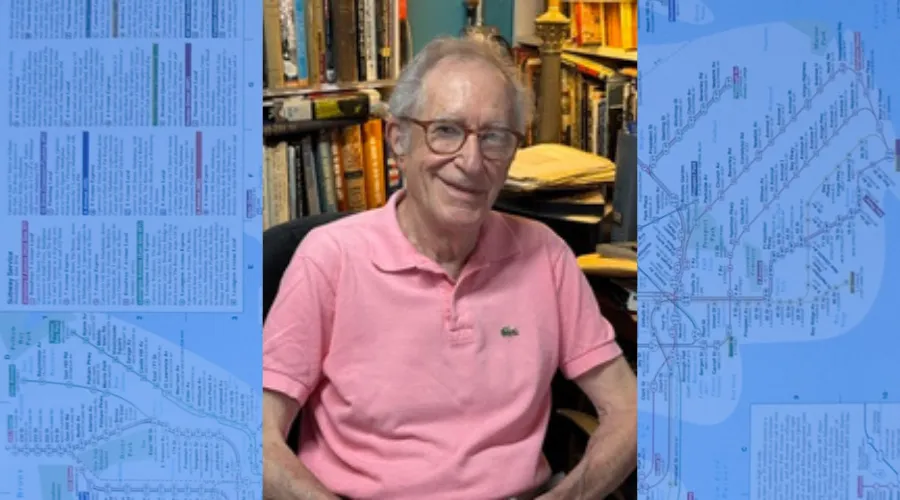
As a child, John Tauranac ’63GS started learning about Manhattan by walking its blocks. He has never stopped.
“You couldn’t walk down the street with my father without hearing about what had happened in one of the buildings,” he recalled of growing up with a single parent who managed hotels in the city.
Later, Tauranac would become a unique chronicler of New York past and present. He led the creation of the map posted in every subway station for the past half century, earning a commendation for design excellence from the National Endowment for the Arts and the U.S. Department of Transportation. His many books, including The Empire State Building: The Making of a Landmark, illuminate the city’s built environment and its social history.
Tauranac, 86, shared these insights with students at New York University for 40 years. As a young man, he wasn’t sure he would ever get into college, much less lecture at one. He struggled to finish high school in five years.
“No college would matriculate me,” he recalled.
Then he found GS. “For people like me, it was basically the last real chance to get an education,” he said. “Did I love GS? Yes. The fact that they gave me a chance—and I’ve lived up to the possibility.”
Unsurprisingly, Tauranac’s memories of Columbia tend toward the architectural. For his study spot, he chose the neoclassical grandeur of Low Memorial Library.
“The Columbia campus is glorious,” Tauranac enthused. “The fact that the steps slope so there is a natural runoff of water— that was a specialty of [seminal architecture firm] McKim, Mead & White.”
Tauranac advises new Columbia students to learn the city through independent study: “Just walk. You start to understand things viscerally.” Tauranac should know: He walked every single block while creating Manhattan Block by Block: A Street Atlas.
The MTA adopted a new subway diagram in 2025, but Tauranac continues to revise and publish his own version, which shows details of the neighborhoods above the subway tunnels. His most recent book, New York’s Scoundrels, Scalawags, and Scrappers: The City in the Last Decade of the Gilded Age, tells the story of 1890s New York.
In recent years, Tauranac has reluctantly left Manhattan for Connecticut, where he feels like “a fish out of water” in a land where one has to get in the car to pick up a quart of milk. But he returns every chance he gets.
“Give me God’s concrete,” he said.