
Presenting the Fall 2025 Bancroft Research Scholars
Congratulations to the newest cohort of scholars who are participating in exciting, funded research with Columbia faculty this fall.
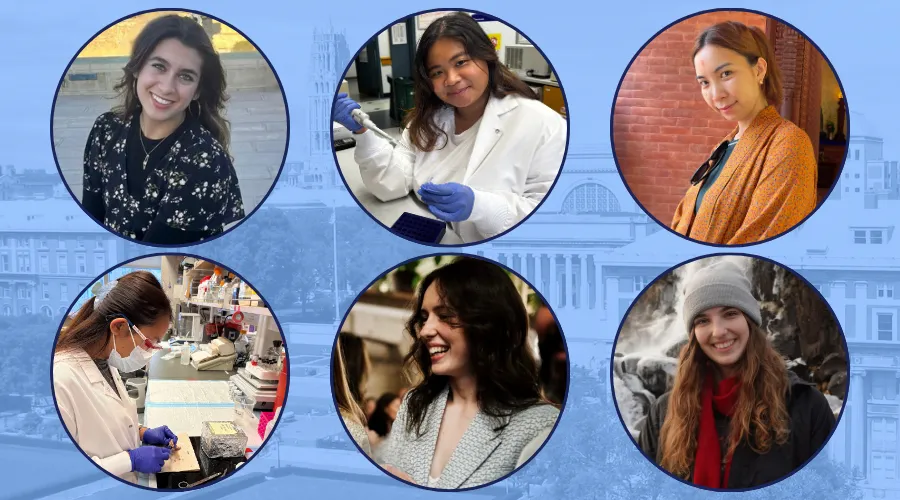
Columbia GS is proud to announce the Fall 2025 Bancroft Research Scholars: Janet Villanueva ‘26GS, Megan Marostica ‘26GS, Melanie Yiyin Zhang ‘26GS, Shira Weiss-Ishai ‘27GS/JTS, Sarah Browne ‘26GS, and May Thinn ‘26GS. The Bancroft Research Scholars Program provides GS students with opportunities and funding to engage in research alongside esteemed Columbia faculty. This semester’s cohort is working on a variety of projects, from genetic engineering to Buddhist ethics to Irish literature. Hear from this semester’s scholars about their cutting-edge research and how the Bancroft Research Scholars Program creates essential opportunities for GS students!
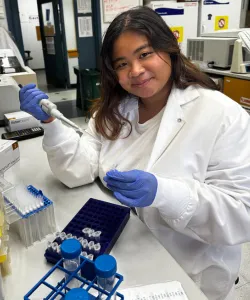
Janet Villanueva ‘26GS
Major: Computational Biology
What research project are you working on?
I am currently working on a project at the Arpaia Lab at Columbia University Irving Medical Center that involves manipulating bacteria through genetic engineering to target colorectal cancer tumors. Ultimately, the goal of my project is to explore the efficacy of a novel bacterial cancer therapy strain as a treatment for colorectal cancer.
Why did you apply to be a Bancroft Research Scholar?
I have been passionate about science and research for as long as I can remember. Having spent most of my life and the first few years of my college years in the Philippines, it's been my goal to advance the field of genetic engineering back home and to make both science and novel healthcare accessible to the Filipino people. As a recent immigrant, I thought of the Bancroft Research Scholars program as a great opportunity for me to be able to pursue the research that I love and move closer to achieving my long-term goals without having to worry about funding, especially as I'm self-supporting and have worked 2-3 jobs alongside a full academic load since I matriculated at GS. Being a Bancroft Research Scholar has allowed me to do just that during my last year at Columbia.
Megan Marostica ‘26GS
Major: Earth Science
What research project are you working on?
I am conducting research on the eruption triggering mechanisms at Poás Volcano, an extremely active volcano in Costa Rica that is only 40 km from San Jose, the capital and largest population center in the country. It is one of Costa Rica's top tourist destinations and its eruptions are sudden and difficult to forecast, making it a high threat volcano. On April 22, 2017, Poás experienced its largest eruption since the 1950s, and while there is extensive gas and seismic data from the eruption, there have been no published studies on the volatile content or pre-eruptive conditions of Poás magma. I am measuring the volatile (H2O, CO2, and S) content of crystal-hosted melt inclusions (magmatic melt trapped during crystal formation that provide a snapshot of the magmatic conditions at time of entrapment) and diffusion profiles of zoned pyroxene crystals to provide the first insights into Poás' pre-eruptive conditions. My preliminary diffusion results show that there was an intrusion of new magma into the chamber shortly before the April 2017 eruption which is corroborated by gas data. This could be the cause of the eruption and I am currently working on creating a more precise timescale of crystal formation, magma mixing, and new magma injection. Broadly, I am working to provide insights into Poás’ subsurface processes and how they affect above-ground activity and hazards.
Why did you apply to be a Bancroft Research Scholar?
I applied to be a Bancroft Research Scholar because I will be presenting my findings at the American Geophysical Union's (AGU) annual meeting in New Orleans in December. AGU is the world's largest meeting of geologists and is an excellent opportunity to learn from leading researchers and connect with the greatest minds in geoscience. With the support of the Bancroft funding, I am able to devote more time to answering the volcano community's questions about Poás and present my results to the broader scientific community.
Melanie Yiyin Zhang ‘26GS
Major: Religion
What research project are you working on?
My project examines how Tibetan Buddhist thinkers resisted sectarian dominance under Qing imperial rule. I focus on the Ri-mé (non-sectarian/unbiased) movement led by Jamgön Kongtrul, exploring how their writings and debates promoted pluralism and nonviolence in a time of political upheaval. By analyzing a legal dispute on Buddhist properties, I show how Buddhist ethics of compassion and dialectical methods created alternative models of legal and political imagination.
Why did you apply to be a Bancroft Research Scholar?
I applied because the Bancroft program enables me to present my findings at major academic conferences, access archival and visual materials, and receive mentorship from leading scholars. These opportunities are essential as I prepare to apply for PhD programs. Just as importantly, being a Bancroft Scholar connects me to a wider research community at Columbia and allows me to contribute my work on Buddhist approaches to pluralism and interdisciplinary conversations.
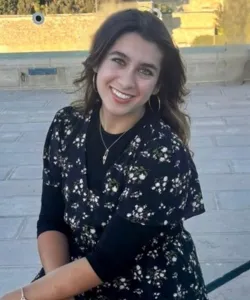
Shira Weiss-Ishai ‘27GS/JTS
Majors: Biochemistry and Jewish Ethics
What research project are you working on?
The project I am currently working on is focused on developing new drug candidates that target a protein called GPX4. This protein plays a critical role in protecting cells from a type of cell death called ferroptosis. Ferroptosis has been linked to both cancer and neurodegenerative diseases, making GPX4 a promising therapeutic target. However, it has been found that GPX4 is a difficult protein to target with the current compounds that have been synthesized for its inhibition. These compounds lack essential “drug-like” properties, meaning they don’t behave in the body the way an effective medication should. My research aims to design and synthesize new compounds that overcome these challenges, in order to improve clinical potential. By optimizing these compounds, I hope to contribute to the development of novel therapies that could induce ferroptosis to selectively kill cancer cells.
Why did you apply to be a Bancroft Research Scholar?
I applied to be a Bancroft Research Scholar because it represents an incredible opportunity to learn and get involved in research, while receiving meaningful support for my academic and professional goals. Research has become one of the most rewarding parts of my education, and the Bancroft Research Scholar Program recognizes and invests in undergraduate researchers, which is both very motivating and deeply impactful. The program not only helps me continue pursuing my research goals but also allows me to focus more fully on developing my skills, learning from mentors, and contributing to projects that could make a real difference.

Sarah Browne ‘26GS
Major: English
What research project are you working on?
My research traces a century of Irish contributions to The New Yorker, a project that has evolved into a meditation on what makes Irish writing distinct. Beyond geography or nationality, Irish literature, both within the island and across the diaspora, is shaped by persistent concerns with occupation, partition, and exile. These preoccupations influence not only narrative and thematic focus but also the formal qualities of the work: its syntactic innovation, inventive grammar, and the cadence and musicality of its language, which together produce a distinctive literary character. My research considers how these elements create continuity within Irish letters while resonating with other literatures emerging from nations marked by division or displacement, revealing patterns of resilience, reinvention, and imaginative memory that are both local and global.
Why did you apply to be a Bancroft Research Scholar?
Having begun this project independently, I quickly realized it was more extensive and had broader applicability than I had initially anticipated. The Bancroft Research Scholars Program provided the opportunity to receive support to dedicate protected time to the work, establish a mentorship with a faculty member, and access the archival resources necessary to advance the transnational research I was already pursuing. With the funding, and in collaboration with the Society of Fellows and the Heyman Center for the Humanities, I have been able to focus sustained attention on the project, deepen its scope, and develop it into an inter-institutional initiative with wider reach. As a Bancroft Research Scholar, I hope to continue developing a career centered on using public humanities to address contemporary political and social questions through international scholarship.
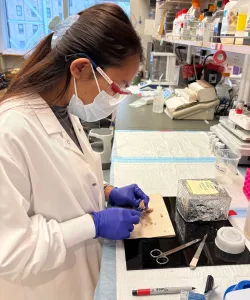
May Thinn ‘26GS
Major: Neuroscience and Behavior
What research project are you working on?
My research focuses on developing a validated method to detect stress and inflammation markers in teeth that could improve our understanding of autism spectrum disorder (ASD) at the Door Lab at New York State Psychiatric Institute Pardes. Specifically, I'm investigating whether we can establish a reliable system using animal models (rats) to measure stress and inflammation biomarkers in teeth, and then apply these methods to human teeth from individuals with autism.
My research project employs a multi-phase approach. I'm working on optimizing the detection of various stress and inflammation markers by testing different antibodies and protein targets to determine which provide the most reliable information. I'm also performing technical methods including tissue fixation, decalcification procedures, staining protocols, and immunofluorescence techniques to ensure our detection methods are both sensitive and specific. Using these validated protocols, I'll analyze human tooth samples to determine whether stress and inflammation patterns observed in controlled animal studies appear in human teeth from individuals with autism. This research aims to establish teeth as powerful diagnostic and research tools for autism spectrum disorder. Unlike blood or urine samples that capture only momentary biological states, teeth preserve a detailed developmental timeline of stress and inflammation—precisely when autism-related changes occur. The ultimate goal is to develop a standardized, reproducible protocol that can advance both autism research and early detection strategies.
Why did you apply to be a Bancroft Research Scholar?
Since working on this project is a volunteer position, applying to the Bancroft Research Scholars Program helps me navigate between my passion for academic pursuits and my personal obligations as a student. The financial support allows me to dedicate meaningful time to research that I'm deeply invested in without compromising my other responsibilities. Additionally, the opportunity to present my research project at the symposium by the end of the year is invaluable—it gives me a platform to share my findings with a larger audience and contribute to the broader conversation about autism research and early detection methods.
About the Bancroft Research Scholars Program
The Bancroft Research Scholars Program aims to provide GS students with the opportunity and funding to participate in undergraduate research during the regular school year. The Program selects a limited number of GS students who collaborate with a Columbia faculty member on a research project during the academic year. Each scholar receives $2,200 in funding for one academic term to support their research efforts. This support helps cover essential research-related expenses, including supplies, materials, and travel costs, ensuring that scholars can fully immerse themselves in their projects without financial barriers.
Stay tuned for applications for the Spring 2026 application!