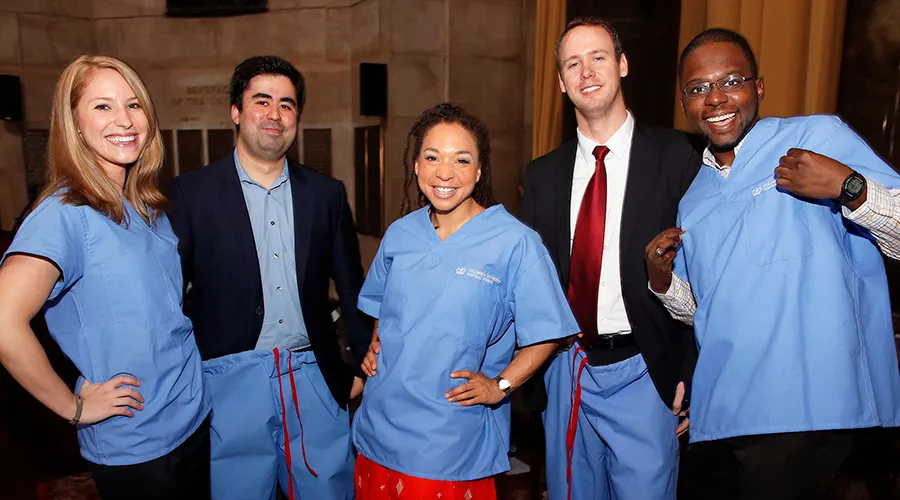
This year's ceremony honored the accomplishments of the nearly 150 students who are completing the program. Some of these students will enter their glide year while others will begin medical school through one of 14 schools with which Columbia maintains a linkage agreement. Honorees were joined by members of the Columbia University Faculty of Arts and Sciences, administrators from the School of General Studies, family, friends, and fellow classmates.
Dean Peter J. Awn opened the ceremony by formally welcoming honorees and their guests. The welcome was followed by the keynote address, given by Linda P. Fried, M.D., M.P.H., Senior Vice President of the Columbia University Medical Center and the first female dean of the Mailman School of Public Health. In her address, Fried explained that a career in medicine is truly a career in health, and that health status is created by a number of factors.
"There is no disease...where some of the causes were not social circumstances patients faced," Fried said.
She declared it essential to redefine what we expect a health system to provide, stressing the importance of addressing social factors by helping to get care for people who can't afford it.
"Health creates the possibilities of a lifetime," explained Fried.
She closed by advocating for a new oath, to complement the Hippocratic oath, which would include a promise to work for social justice and population health, joining the fields of medicine and public health.
The keynote address was followed by the presentation of the graduates by Associate Dean Andrew Sunshine, Postbac Premed Program director, each of whom was individually congratulated by faculty members, administrators, and Dr. Fried.
After the presentation, Evan Frederickson Joiner delivered the student address, and spoke about the humbling experience of returning to school to pursue medicine, which requires that one set aside what they've been doing and "enter one of the longest professional training sequences on offer."
Joiner also praised his fellow students, who he explained come from varied backgrounds that include careers as lawyers, painters, financial analysts, college athletes, teachers, and soldiers.
"Our careers will be all the richer for the wide-ranging experiences we bring to them," he said. Lastly, Joiner expressed his belief that the decision to study medicine requires faith.
"We do not know from an experience of doctoring that we will find the work of doctoring meaningful, but we believe fiercely that it will be," he said.