
Making the World a Better Place Through Climate System Science
Ahinoam Toubia '25GS discusses researching minerals at the American Museum of Natural History and why she's passionate about the climate and science.
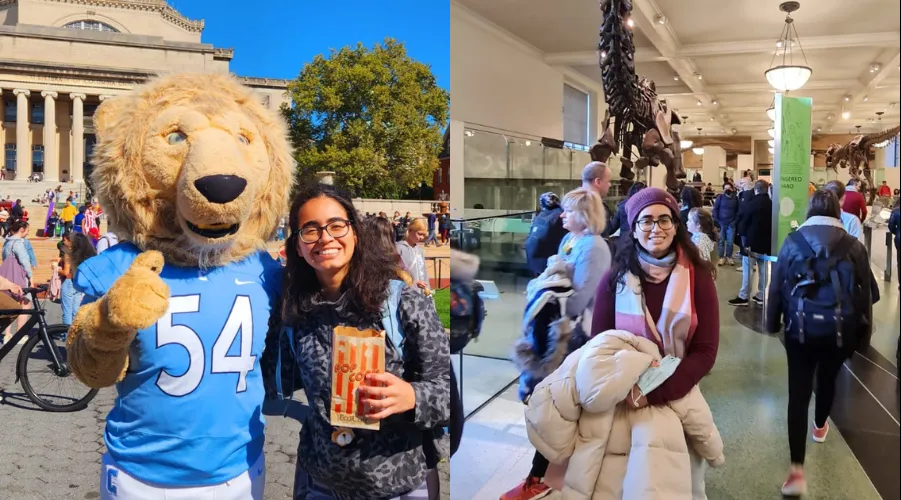
Ahinoam Toubia ‘25GS shares her experiences at Columbia GS as an international student from Israel and the research she’s currently working on at the American Museum of Natural History analyzing serpentinite rocks and minerals.
Tell us your GS story!
Hello GS community! My name is Ahinoam Toubia, and I’m an international student from Israel. My journey to GS began when I was 10 years old. During a summer trip to New York, my parents thought it would be a great idea to enroll me in Columbia's children's summer camp with my American cousins. Although I didn’t know a word of English, I thoroughly enjoyed the experience and was amazed by Columbia’s campus. Years later, I worked at the Israeli Ministry of Defense as part of an IT management team, where I built communication networks and safeguarded data. In my final year of service, I began thinking about my next steps. I hadn’t considered studying abroad but I knew I wanted to study climate. After struggling to find an undergraduate program in Israel that focused only on climate, I thought back to my time at Columbia’s summer camp and its beautiful campus. That memory inspired me to apply to Columbia and be a part of the GS community.
What are you majoring in and how did you decide on what major to pursue?
I decided to major in climate system science because I love nature and I am curious about how the world works. I also like STEM, especially physics and chemistry and together with my passion to make the world a better place, this major is a great fit for me.
What is your favorite class right now?
My favorite class right now is Computational Earth Science with Professor Dan Westervelt. Not only is Professor Westervelt amazing, but the class itself is incredibly engaging. We learn how to use Python to build climate simulations and models, and I’m gaining highly practical skills. I’d definitely recommend it!
How did you get involved in research at Columbia and what project have you been working on?
I conduct research at the American Museum of Natural History (AMNH) as part of my climate major, which requires writing a thesis based on my research. This semester I joined an amazing lab at the museum focused on geochemistry, where I analyze serpentinite rocks and minerals using advanced technologies like the Infrared Spectrometer (FTIR) and Electron Probe Micro Analyzer (EPMA).
Is your thesis going to be based off of the work you are doing at the AMNH? Would you mind sharing the topic?
Yes! My thesis is based on the research I do at the AMNH. My research concentrates on analyzing rock samples from two different locations in Cuba, focusing on serpentinite rocks. Serpentinite is a metamorphic rock that is made up of serpentine minerals. It is formed at the ocean floor and subduction zones when ocean water percolates through magnesium- and iron-rich rocks such as peridotite in the upper mantle. My study at the AMNH aims to offer important insights into the formation and role of serpentinite within tectonic settings, especially in subduction zones where it influences fluid release, seismic activity, and geochemical cycles. The expected findings should deepen our understanding of serpentinization processes, with broader implications for the fields of geochemistry and tectonics.
What does a “typical” shift at the museum look like for you? What specifically do you work on?
I go to the museum once a week and when I am there, a “typical” shift for me is looking at the rocks using the FTIR and EPMA. I analyze the data I receive, interpret it, and build maps based on the chemical composition of the minerals.
What is your favorite thing about working there?
There are several things I like about working at the AMNH. The location is convenient and not too far from campus, the staff working there is super nice and my research mentor is the best research mentor in the world. She is super professional and I never met someone as passionate about rocks as she is. I also enjoy working with technology. The AMNH has amazing microscopes and spectrometers so I feel like I am gaining practical and useful experience that I will apply in the future.
What has been the most challenging part of your role?
The most challenging part is to analyze the data. There is so much data collected about the rock samples (isotope patterns, trace elements, mineral structure, and chemical composition) and that can somewhat make me feel overwhelmed and lost. With more experience in the lab, I hope to gain confidence in managing large datasets.
What advice would you give to other students looking to get involved in research at Columbia?
If you are looking to be involved in research, at Columbia or at any other place, start as soon as you can! Be open minded about the research topics and network with people in your field. From my experience, it's hard to find research but don't give up, you got this!
What are your next steps for when you graduate?
I am not sure about my steps after graduation, but I hope that by studying climate science I can make the world a better place.