
Fast Five: Driving Stories Forward with Filmmaker Andree Svetozar Ljutica '25GS
Balancing school, family, and creative work, the GS alumnus found new clarity in both his Columbia education and his filmmaking.
Welcome to Fast Five: Rapid-fire, insightful interviews with GS students and alumni!
Ask documentary filmmaker Andree Svetozar Ljutica '25GS what the most challenging part of filming in a New York City taxi cab is and his response might surprise you. Is it all the red lights? Waiting for throngs of people to cross the street? Not quite.
“Potholes,” he said.
The GS alumnus made his debut feature film last fall; a documentary about one night in his father’s NYC taxi and the intimate exchanges with different passengers who came into the cab. Ljutica shares more about what made this story so personal and timely—along with what it was like coming back to the classroom after significant time away.
What is your GS story?
Returning to school after so much time away from academia was an intimidating premise. I feared the inevitable balancing act of work, school, parenting; of being an older student with career obligations. I feared alienation and the start of something I might not care to finish. Ultimately, I was inspired by two friends who, like me, took a part-time path with GS and ultimately extolled the experience for what they each gained with networking, personal growth, and of course, knowledge.
For years, this idea of returning to school seemed abstract and the reality increasingly distal. The pandemic, in all its mystery and chaos, offered a necessary pause and the space to meditate on the next phase of my life. I was also starting a family. Moreover, the decision to invest in myself during a moment of global unrest and personal transition felt enormously privileged, but also necessary. Then, as is also the case now, I wanted to be able to approach each new project, artistic or commercial, and any new professional challenge with the fullest amount of references, intellect, and ideas that I could. I suspected that what I would gain from a writing program at Columbia would fortify the diverse trends of my career in the arts.
Now, as I navigate film, writing, photography, as well as a commercial branding and strategy practice of my own, the robust learning from this focused time in school feels like a super power. I feel oriented and my artistic practice feels supported by not only this knowledge base but an understanding of how to keep this machine of personal learning going.
What inspired you to tell the story of your father in “Taksi,” and how did your personal connection shape the film?
“Taksi” is my debut feature film. It's an intimate portrait of a Montenegrin immigrant (my father) behind the wheel of his New York City taxi cab. This film came to life in the fall of 2025, a time during which I felt especially discouraged by the political injunctions being placed against the immigrant class and this sort of collective fear especially plaguing the formerly incarcerated, like my father. Here, I'm referring to a sense of entrapment—that one cannot really come and go as one pleases—and thematically, this became a really attractive filmic space.
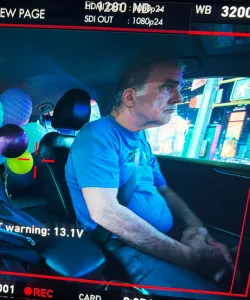
The tension between the notion of American freedom and this imposed political inertia became the basis of a highly minimalistic film language where my own authorship of the project weaves itself between these episodes and my father's reflections on a very different New York from the one he came into. Taking place across one night, the camera never leaves the interior of his cab, which ultimately, becomes a place of intimate exchange between my father and five passengers. There is comedy, fear, isolation, and a sense of unease.
Also, potholes are not fun when one is folded in half in the very back of a Toyota Rav-4.
Your work often explores immigrant experiences. How has your own journey influenced the stories you choose to tell?
I have now made two films on some aspect of an immigrant's experience in America. The first was a dark comedy called, “Punta Cana,” about the end of one Serbian immigrant's American tour working as a country club golf ball diver. These stories, however ridiculous or serious, allow me to investigate an aspect of humanity that, for whatever reason, has always interested me: alienation. The films of Bresson, Schrader, Antonioni helped me understand how something so universal can live within the individual. What the characters from “Punta Cana” and “Taksi” share is this sense of displacement and suspension. I think there is something here that everyone can relate to.
Your project on Mount Etna focuses on the environment and small wineries. How do you approach blending social or environmental themes with personal narratives in your work?
In addition to “Taksi,” I am also in the middle of production on another feature documentary called “Rare Animals.” It is a full length version of the short precursor, “Wildfire,” which can be viewed on Documentary +. Both films explore a tension between the personal and the monumental. In “Rare Animals,” the chief investigations are manifold, exploring the slow creep of industrialization as well as the localized effects of climate change across Sicily: drought, fire, and increased volcanic activity. At its core, the film seeks to answer a question: what does it mean to be making something in a world that is dying? To do this, the film places a very special natural winemaker/poet/electronic artist at the core and allows his interiority to become a mirror for the exterior drama unfolding beyond his control.
As an independent director, what advice would you give to students or emerging filmmakers interested in telling authentic, personal stories?
There is some feeling that is very hard to describe when you're in the middle of making something worthwhile. Here, this sense of purpose acts like a tail wind. The motivation is not hard to gather. There are sparks in the eyes of your collaborators. Things move quickly, but intelligently. You are on tenterhooks. Chase this space, however you can. Practically, start with the things you have access to. If what you have access to feels boring or uninteresting, get into trouble.