
The Dream Didn’t End—It Waited
After years of putting survival first, Batoul (Tooli) Shariah ‘26GS reclaimed her education and is carrying her story into research, advocacy, and graduate study at Oxford.
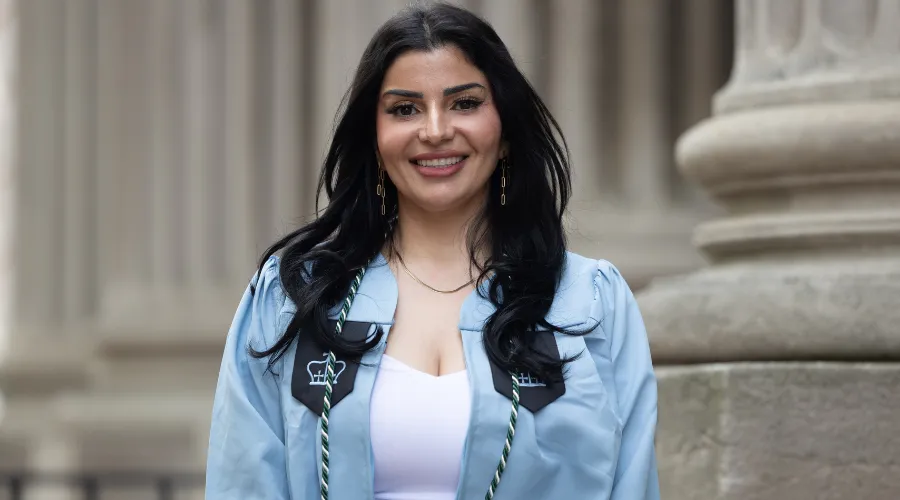
“I wake up at 4:00 a.m., full of purpose, and commute from Philadelphia to New York each morning. Passing the Statue of Liberty on my way to Columbia, I am reminded of my journey.”
For Batoul (Tooli) Shariah ‘26GS, this daily ritual is more than a schedule—it is proof that the life she once thought lost is firmly in motion. Like many of her GS classmates, she describes her path to Columbia as, “anything but traditional.” It’s one that’s been shaped by loss, responsibility, and a quiet determination that endured even when her dreams of getting an education felt out of reach.
Raised in Amman, Jordan, she moved between city life and Bedouin life. Her father was an early inspiration for Shariah, teaching her how to read the desert and find meaning in the world around her; encouraging her to notice the small details, which others often overlook. “He showed me that knowledge was not confined to books, but lived in people, land, and memory,” she said. “He was the center of my life.”
When he passed away from cancer before she turned 16, everything shifted: she left school and began working to support her family. “I was forced to choose between survival and becoming the person I had once imagined I could be,” she recalled. “Immediate responsibilities made education feel distant. The future I had imagined did not disappear; it slipped out of reach.”
Moving to the United States was the catalyst that started Shariah on a new path. In 2021, she was accepted into the Octavius V. Catto Scholarship Program at the Community College of Philadelphia, an opportunity that restored not just access to education, but also momentum. At GS, she’s double majoring in Middle Eastern, South Asian, and African Studies (MESAAS) and human rights, fields that reflect both her personal history and commitment to understanding power, identity, and justice across borders. She carries that sense of purpose into every early morning commute, the Statue of Liberty serving as a daily reminder of what it means to begin again.
At Columbia, her academic work has been deeply personal. Guided by mentors like Political Sciences Professor Andrew Nathan, MESAS Professor Muhsin al Musawi (who also served as her thesis advisor), and GS Senior Assistant Dean for Academic Affairs Glenn Novarr, she conducted research in Jordan, interviewed policymakers and community leaders, completed two senior theses, and applied for numerous prestigious scholarships and educational opportunities, Through this, she came to see her Bedouin heritage not as something separate from scholarship, but essential to it.
"GS is full of people who genuinely want to see you succeed, not out of obligation, but because they recognize the weight of your journey. Their support can open doors you do not even know exist yet.”
It’s this network of mentorship and support that now shapes the advice she offers to other GS students: “Let people help you. Build real relationships with your advisors, deans, and professors. GS is full of people who genuinely want to see you succeed, not out of obligation, but because they recognize the weight of your journey. Their support can open doors you do not even know exist yet.”
Her myriad achievements reflect her steadfast determination and are more than simply lines on her resume. “One of the defining parts of my GS experience has been learning to take chances. I applied for awards, fellowships, and opportunities I once thought were beyond me. Each time, I learned that rejection is not a verdict; it is a redirection.”
It was precisely that mindset that opened doors to opportunities she once thought to be unimaginable, including being named a Marshall Scholar candidate (and advancing to the final round) and her next step: pursuing an MPhil in history at Oxford. Of her accomplishments, and yes, the rejections too, she said, “They are the echo of every early morning, every sacrifice, every moment I chose to believe that the girl who once carried her family’s weight could also carry her own dreams.”
Reflecting on her time at Columbia, she said, “GS gave me more than an education; it gave me community, support, and the ability to imagine a future again. For someone who once believed that the future had disappeared, this has meant everything. The dream did not end. It waited. And now, it continues.”
Looking ahead, Shariah hopes to build a life in scholarship, research, and advocacy, writing histories that have been left out of the archive—especially those of Bedouin women she grew up watching lead caravans and mediate disputes. She also envisions creating an institution to support young women facing systemic barriers to education and autonomy. “This vision is deeply personal,” she said. “It is my promise that no other girl should have to choose between survival and becoming who she is meant to be. My father taught me to read the desert. Now I want to teach others to read their own possibilities.”
That same sense of purpose shapes the message she leaves for others still finding their way: “To anyone reading this who is still waiting: your moment is not lost. It is gathering itself, just like you are. Keep waking up at 4:00 a.m. Keep passing your own Statue of Liberty. Keep going.”