
Curiosity on Display: GS Students Shine at Columbia’s Undergraduate Research Symposium
Nearly 40 GSers presented projects spanning neuroscience, philosophy, and archaeology—showcasing the power of research to connect classroom learning with real-world impact.
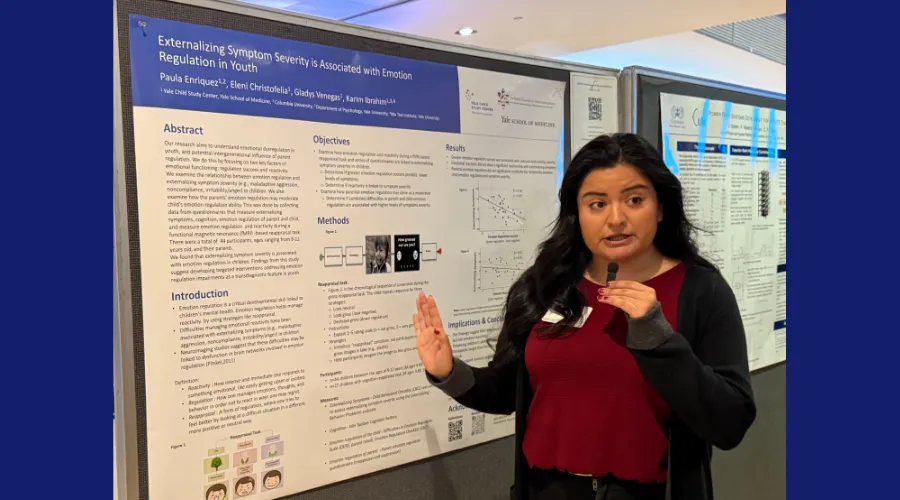
Each year, Columbia’s Undergraduate Research Symposium gives students from Columbia's four undergraduate colleges the opportunity to present their research in any discipline to the broader Columbia community. Attendees can learn more about research opportunities and vote on the best poster design! At this year’s symposium, hosted on Friday, October 17 in Roone Arledge Auditorium, nearly 40 GSers presented their work.
Engaging in undergraduate research is a valuable addition to the GS experience, explained Dean Jie (Jenny) Li, GS Senior Assistant Dean for Academic Affairs. “Participating in research allows GS students to apply classroom learning to real-world questions, deepen their academic interests, and develop valuable analytical and communication skills.”
And the symposium is a fantastic place to share this critical research. Dean Li added: “Presenting their work at the symposium not only builds confidence and professional experience but also gives them the chance to share their unique perspectives and inspire others in the Columbia community.”
This year, GS students’ research stretched across disciplines and topics, from neuroscience to philosophy to archaeology. One student analyzed the media craze around a famous death, another looked at mitochondrial morphology regulation, and one examined a NYC nightclub. Read more about the vast array of research topics this year's GSers undertook below!
“Presenting their work at the symposium not only builds confidence and professional experience but also gives them the chance to share their unique perspectives and inspire others in the Columbia community.”
Una Aleksic ‘26GS, Psychology
Psychosis Proneness in the Aftermath of Trauma: Cognitive, Affective, and Personality Pathways
Luiz Backes ‘27GS, Mathematics (with Lucas Azenha ’27CC and Pranav Suesh ’27CC)
From Nests to Networks: Modeling Supercolony Structure in Social Weavers
Caroline Baldessin ‘26GS, Psychology
“Pink Cocaine” Panic: Media Sensationalism and the Death of Liam Payne
Uriel Benymon ‘27GS, Computer Science
Exploring Improvements to B-Tree Index Structures for Database Optimization
Lindsey Brown ‘26GS, Neuroscience and Behavior (with Owen Puhl ’28CC)
Doing Global Research: Challenges and Recommendations based on a 26-country study
Mara Bulzan ‘26GS, Human Rights, Political Science
Staging the Deportations to Transnistria: Romania’s Violent Performance of the Roma Holocaust
Ana Castro ‘27GS, Neuroscience
Gpr75 Deletion in Adipocytes Protects from Diet Induced Obesity: Changes in Glucose Homeostasis and Inflammatory Responses
Gabriel Caumartin ‘26GS, Neuroscience and Behavior
Generating a brain-wide atlas of neuronal activity during myocardial infarction recovery
Debpriya Das ‘26GS, Biology
The Trade-Off of a Beating Heart: How Cardiomyocytes Sacrifice Regeneration for Strength
Paula Enriquez ‘27GS, Psychology
Externalizing Symptom Severity is Associated with Emotion Regulation in Youth
Jordan Faulk ‘26GS, Philosophy
Individual Ethical Behavior Interval
Helene Goldberg ‘26GS, Psychology
Searching for the Fountain of Youth: Exploring the Relationship Between the Serotonergic System and Age-Related Cognitive Decline
Payge Hardy ‘26GS, Philosophy
The Labor of Moral Return
Sophia Ho ‘26GS, Neuroscience and Behavior
The role of neuromodulatory infraslow oscillations in linking sleep and chronic pain
Charles Ibitamuno ‘26GS, Applied Mathematics
Machine Learning for Hour-Ahead Solar Radiation Prediction in Seattle, WA
Kay Kaiser ‘27GS, Earth Science
Does My Drinking Water Have Uranium?: Using machine learning to predict uranium levels in regions of untested well water in New Jersey
Justin Kiel ‘27GS, Political Science
Selective Enforcement: Prosecutorial Discretion and the Non- Enforcement of Political Misconduct in Indiana
Emily Lee ‘28GS, Biochemistry
Investigating the population structure of microglia in the aged African American brain
Margaret Li ‘26GS, Art History
Meyer Schapiro and Fernand Leger: A Dialogue Between Medieval and Modern Art
Josh Lohmolder ‘28GS, Astrophysics
Dissociative Recombination Rate Coefficient Fits for Modeling the Evolution of Interstellar Clouds.
Yuval Mazor ‘27GS, Psychology
Tracking βIII-tubulin-Positive Neurons with Endogenous Membrane GFP
Ginnie McKnight ‘27GS, Political Science
Art based research as a modal praxis in depicting and solving AI innovation disparities in spatial geography dispossession, energy depletion, and ethical data acquisition methodology.
Pedro Henrique Meerbaum ‘27GS, Comparative Literature and Society
Maia Zasler ‘27GS, Sustainable Development
Fragmented Memories: Exploring the Impact of Cultural Preservation and Revitalization Policies on the Moroccan Jewish Community
Chloe Muller ‘28GS, Chemistry
Fostering Inclusiveness in Physics for Undergraduate Women
Han Nguyen-Luu ‘27GS, Sustainable Development
Identification and Quantification of Micro- and Nano-plastics in Common Soft Drinks in the US
Glenn Paul ‘27GS, Sociology
The Art of Chaos: How Does NYC Nightclub Reinvent Nightlife through Organised Innovation
Melina Rozehkhan ‘26GS, Political Science
From Tunisia to Iran: The Role of Women in Shaping Protest and Democratic Transition
Nima Sedghi ‘27GS, Biological Sciences
Investigating the Regulation of Mitochondrial Morphology and mtDNA
Liv Shalom ‘26GS, Chemical Physics
Near-Infrared Lithography with MoOCl2
Tooli Shariah ‘26GS, Human Rights, Middle Eastern, South Asian, and African Studies
My Best Friend the Goat: Bedouin Bonds with Camels, Goats, and the Art of Survival
Anand Shukla-Parekh ‘27GS, Philosophy
Can Patients Truly Give Informed Consent To Transformative Medical Procedures?
Tyler Sotomayor ‘27GS, Economics-Mathematics
When the Message Meets the Moment: State-Dependent Effects of Monetary Policy and Information Shocks on the Term Structure of Inflation Expectations
Marc Stoyer ‘26GS, Astrophysics
Extending Comparisons of Non-Gaussian Weak Lensing Statistics Between Baryonic Correction Models and Hydrodynamical Simulations
Jeremy Switzer ‘26GS, Archaeology
Preliminary archaeobotanical results from fieldwork in highland Madagascar
Kah Sin Tang ‘26GS, Evolutionary Biology of the Human Species
Rainbows in a Feather: Structural Color and Iridescence in the Wing and Breast Plumage of Superb Starlings
Bambi Yi ‘26GS, Biology
Establishing Reliable Qualitative Coding with Johnstone's Triangle in Chemistry Education Research
Kai Zhang ‘26GS, Computer Science
Interior-Point Constraints for Parallel Multi-Shooting DDP
Melanie Zhang ‘26GS, Religion
Tibetan Buddhist Approaches to Social Action: the 1750 Lhasa Uprising