
Creating Space: A Journalist’s Dedication to Telling Underrepresented Stories
Ime Ekpo ‘26GS reflects on the ways her journalism career pushed her back into the classroom, and how her research influences her connection to culture and power.
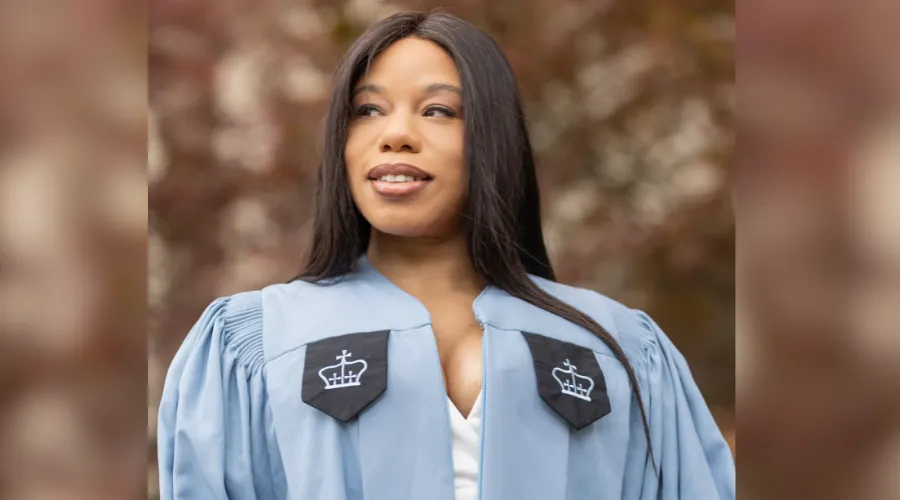
Ime Ekpo ‘26GS credits her impressive journalistic career to her first Tumblr blog about classic hip-hop. Her writing and research focus on underrepresented communities, and she’s never been one to shy away from creating space where there previously was none. As the first graduate of the BMCC-Columbia NYC Scholars Program, Ekpo reflects on her time at both BMCC and GS and the ways she will be furthering her career beyond the classroom.
Tell us about your path to GS.
After graduating from Curtis High School in 2009, I left Staten Island to attend the University of Maryland Eastern Shore, where I studied computer science for three semesters. I excelled academically, but I didn't have the support I needed to finish. Returning to New York, I landed a job as a telemarketer at a debt consolidation firm in midtown, became a top performer with 83.4% of my leads closing, and was eventually promoted into management, running a marketing floor of over 50 representatives. I was good at it. But I was burning out, and the whole time, quietly and aggressively, I was pursuing something else entirely.
In 2013, I created a Tumblr blog called Old School Hip-Hop Lust out of a genuine, almost obsessive devotion to classic hip-hop. It grew into a publication with a dedicated audience, and somewhere in that process, without fully realizing it, I had become a journalist.
By 2017, what began as a passion had evolved into a profession. Joining The Source marked my entry into professional journalism, where I covered the modern happenings of hip-hop's classic acts. The Nigerian music scene came a few years later, writing for BellaNaija, where I began drawing connections between contemporary African artists and their roots, including a piece exploring how Tiwa Savage's 49-99 was influenced by Fela's “Shuffering and Shmiling.”
The pandemic clarified something I had already been feeling. My journalism had been pulling me toward research for years, drawing me deeper into archives, into context, into questions that lived beyond the news cycle. I wanted to teach these histories and contribute to a more comprehensive curriculum, particularly around the omissions I kept encountering in how Nigerian and African history are taught. That recognition led me to return to school at the Borough of Manhattan Community College in Spring 2021.
At BMCC, I became a member of Phi Theta Kappa, serving as president of the Alpha Kappa chapter, and also served as a Library Peer Ambassador. I completed an Honors Project titled "The Yin and Yang: Nontraditional Students at BMCC" and received the NBCU Academy Scholarship. Participating as a student researcher in the Black Studies Across the Americas cohort was perhaps the most formative experience of my time there, giving me my first sustained engagement with academic research. One semester, I traced the chronological history of the Garifuna, an Afro-indigenous group whose story is rarely told in full, and the next semester I researched the relationship between Toussaint and Dessalines during the Haitian Revolution. From that research, I developed open educational resources for students and instructors who want to engage these subjects seriously, materials built to fill some of the very gaps I had long been frustrated by. I graduated in Fall 2023 and applied to Columbia that same semester.
I had spent years in self-directed study, reading Diop, Fanon, Jochannan, and Clarke during my time as a member of the Five Percent Nation of Gods and Earths. That experience launched a journey of self-scholarship that filled the years between my time at UMES and eventually arriving at Columbia. I wanted a proper foundational understanding of African history, and I found that through Mamadou Diouf. His scholarship on African intellectual history, its historiography, and particularly Islam in Africa spoke directly to questions I had been sitting with for years. I enrolled in three of his courses, including Pan-Africanism and Africa Before Colonialism, and each one gave me more of the framework I had been building toward on my own for years. Columbia being a research intensive institution meant I would finally have the space to explore my most pressing intellectual wonders, not only through the depth of resources the library affords, but through opportunities like the undergraduate thesis, which gave me the chance to produce original scholarship on a subject I had been circling my entire life.
What has been your proudest moment at Columbia?:
Writing my thesis, "The Manichean East: Applying Fanon to the Ibibio Experience of Inter-Tribal Conflict During the Nigerian Civil War," was the most intellectually demanding thing I have ever done, and among my proudest accomplishments here. Applying Fanon's framework to a history as specific and as personal as the Ibibio experience required me to hold two things at once, rigorous theoretical analysis and a deep, almost intimate investment in the subject matter. As a Nigerian of Ibibio descent, I'd grown up acutely aware of how much of our history is either underrepresented or misrepresented in the broader narrative, the precolonial period, the pre-independence era, the complex story of minority ethnic groups in Eastern Nigeria, including questions I carried personally, like whether figures such as Yakubu Gowon should be considered heroes or something far more complicated.
I had grown up admiring figures like Winnie Mandela for her refusal to be diminished, reading scholars like Catherine Acholonu, sitting with the ideas of Nkrumah, and spending years in my journalism circling questions without a framework large enough to hold them. At Columbia, through MESAAS, I finally had that framework. But the work also revealed its own wound. The oral histories of Ibibio people who witnessed the atrocities of the Civil War firsthand, some of them still alive in Akwa Ibom State, remained out of reach. There was no time to travel to Nigeria, to sit with elders, to do the community-based archival work this history truly deserves, which is why expanding this research during my PhD is the obligation I feel most clearly. Presenting at the Pan-Africanism & Education conference at Teachers College this spring only deepened that conviction, and it meant something particular to me knowing I was the only undergraduate in that room.
But if the thesis is my proudest intellectual achievement, then founding the AfroDiaspora Colloquium is my proudest act of institution-building. I created it because I saw a gap. There weren't enough spaces at Columbia that centered African and diasporic voices in a way that felt culturally grounded, that brought scholarship, culture, and lived experience into the same room. Our inaugural event, a conversation with Afrobeats artist Asake that drew over 100 RSVPs to Knox Hall, made clear there was real appetite for African programming at Columbia.
Tell us about a class that was instrumental to you during your time at GS.
One of the most instrumental classes for me at Columbia was Fanon’s Psychology of the Oppressed with Professor Colin Wayne Leach. Fanon’s ideas about the colonial world being structured through division and opposition really resonated with me, especially in relation to Nigerian history and the marginalization of minority groups like the Ibibio.
Professor Leach allowed my classmates and me to be very critical of Fanon by questioning and reinterpreting his ideas. He encouraged us to apply and even reimagine Fanon’s concepts in relation to the modern realities that concern us.
That course continues to shape how I approach my research, where I apply Fanon’s concept of the Manichean colonial world to the Ibibio experience during the Nigerian Civil War, as well as how I think about the role I want to play as a historian.
What advice would you give to a student who's about to start their GS journey?
Never underestimate office hours. Columbia has some of the most accomplished scholars in the world sitting right across from you, and that access is something most people never get. Take the time to familiarize yourself with your professors' scholarship before you walk through that door. Know what they have written, what questions they are sitting with, and come ready to engage. Those conversations can shape your thinking in ways that a lecture alone never will. And do not wait until something goes wrong to communicate with your professors. The moment you feel a concern rising, address it. Open, honest communication with your professors is one of the most underutilized tools a student has.
What are your plans for after graduation?:
After graduation, I will be working as a Faculty Coordinator with The School of The New York Times. In the fall, I will begin pursuing my M.S. at Columbia Journalism School, and in Fall 2027, I will continue my graduate studies with the Technology, Policy, and Innovation Program at Columbia SIPA as part of a dual graduate degree, while continuing my work as a cultural journalist and a Forbes Hollywood and Entertainment contributor. I will also be expanding the AfroDiaspora Colloquium.
Is there anything else about your GS story that you’d like to share?
At WKCR, I programmed my own version of the legendary Stretch and Bobbito slot, calling it Offbeat: The Rap Archive, and opening every show with "This is Ime, your crate digging '90s baby." It was my way of honoring that tradition and bringing classic hip-hop back to that frequency. I also created Stereo Sankofa, my version of The African Show, dedicated entirely to the music of the African continent, because that story deserved its own space on that dial 89.9.
Beyond radio, I interned as a print editor for the Columbia Journal of History and launched the AfroColumbia column at the Columbia Daily Spectator, where I published a piece concerning the state of African studies at Columbia.