
Choosing Difficulty on Purpose: A Veteran’s Long, Winding Road to Columbia GS
Witnessing 9/11 as a teenager propelled former Army medic and firefighter Patrick Johnson ’26GS into years of service, loss, and recovery—ultimately leading him to forge a hard-earned path to Columbia.
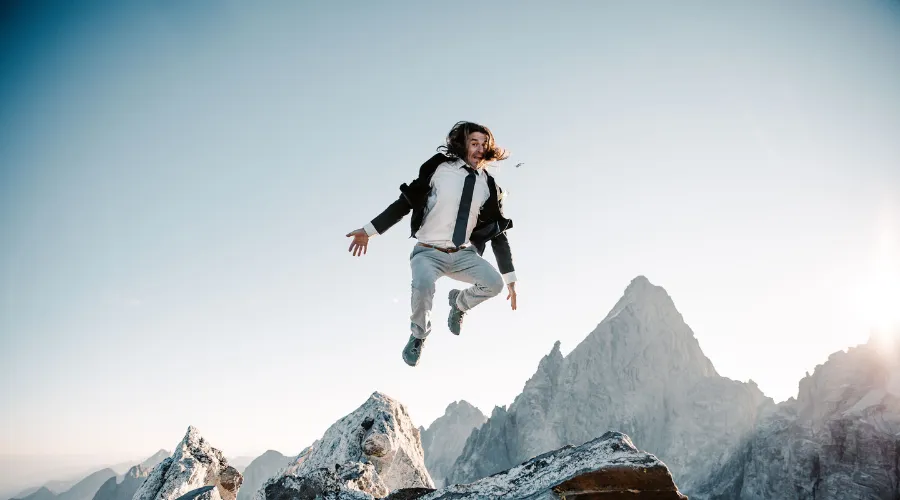
Johnson reflects on how unconventional life experiences can fuel intellectual and personal success.
Tell us about your path to GS:
It's a cosmic irony that my long and winding path to Columbia University's School of General Studies should be bookended by the Manhattan skyline. Almost none of it was planned, which is probably why it makes a certain kind of sense in retrospect. I came to GS by way of fire, empire, war, loss, grief, addiction, and the odd miracle of surviving myself.
I was just sixteen and fairly aimless until a Panasonic tube television was frantically wheeled into my history class one beautiful September morning. A transfixed Dan Rather, live and in short-sleeves, cuts to a distant wide-angle shot: black smoke chugging from the leeward side of what the CBS news scrawl has labeled 'World Trade Center — North Tower,' whose exposed latticework of girders and broken columns looks less like architecture than the ruined, fiery skeleton of an ideal we'd all collectively mistaken for permanence. Tiny figures appear in the seams of these broken windows above the involved fire floors; they hesitate, then drop in vertical free-fall through the television frame. Some fall alone. Some fall in pairs.
Shaky close-up footage catches and momentarily tracks a man in business casual attire descending upright through the air, necktie lifting almost absurdly vertical, hand-in-hand with a woman preceded by her own high heels, face obscured by the upward billow of her skirt. What I remember now is not the image itself but the collective sound in the room: the entirety of my sophomore U.S. history class gasping all at once, as if breath itself might alter what was happening.
By the time both towers fell—like many boys of my generation who'd confused proximity to history with mandate—I took that morning personally. Before I'm old enough to buy a drink, I've already deployed as an Army medic. Then came Afghanistan's ruggedly mountainous Kunar Province, where time moved strangely and death acquired euphemisms—just one of the many ways institutions teach people to survive what they're doing long enough to keep doing it.
Then came the fire department, and in those 12 years of service, more funerals than any institution should require for membership. Somewhere in all that accumulated haze, my mother died of leukemia. Painkillers became emotional currency; hard narcotics became the exchange rate. I called in sick one morning only to accidentally overdose in the parking lot of a Bob's Discount Furniture, which even now sounds less like autobiography than American satire—except that it happened, and I awoke to find my own engine crew standing over me as though the world had decided, with some reluctance, not to be rid of me just yet.
That was, depending on your theology, either the punchline or the intervention.
What recovery gave me was not redemption in any clean or cinematic sense but literature, which turned out to be more useful anyway. A psychologist had recognized this innately, handing me an empty notebook to fill with my thoughts and feelings. In a fluorescent-lit VA psychiatric hospital smelling faintly of piss overpowered by industrial lemon floor cleaner and quiet desperation, I'd write until I couldn't, and then I'd read everything I could get my hands on to pass the time—the usual patron saints of damage and transfiguration, Dostoevsky and Baldwin and Keats and the rest—until writing ceased to feel ornamental. It became diagnostic. Then necessary: a way of examining pain closely enough that it might yield meaning instead of merely repetition. One miserable Fourth of July, I sat in a battered chair beside a barred window that didn't open, reading Keats on Negative Capability—this unworldly capacity to remain "in uncertainties, mysteries, doubts, without any irritable reaching after fact and reason." Keats meant it as a theory of art. I read it as the most honest description of the life I'd been living; a theory of survival. I'm still not sure he'd mind the difference.
I began attempting to understand the strange intersection of suffering and resilience, of whatever backward species of faith survives after faith in oneself has proven not just unreliable but structurally unsound. Why do some survive what should flatten them, and why do others not? What, exactly, does survival obligate?
I returned to work on Engine 16 and fought the old wars quietly for years, until eventually, after a string of preventable line-of-duty deaths—each one metabolized not as grief but as accrued PTSD—I was rendered a shadow of myself. I made the impossible decision to resign from the fire department after 12 years of service, which felt less like abandoning an identity than admitting that the identity, at least in its old form, had already abandoned me.
But sobriety had introduced me to alpine rock climbing, and so my partner and I moved west. Together we climbed mountains. Eventually, we got married on one. On a whim, I enrolled at Arizona State and then kept going, because by then I'd finally understood two things: first, that whatever raw talent I had was worthless without discipline; and second, that time is never guaranteed and therefore should not be spent rehearsing a life you do not actually want to lead. Applying to Columbia represented the opposite of the life I'd lived—mostly by inertia, mostly by letting momentum impersonate purpose. Getting in meant choosing difficulty on purpose. That, for me, was the real plot twist.
I wanted rigor. Difficulty. Transformation. I wanted to earn my life in a different language.
That's my path to GS:
not straight,
not sensible,
but, for once,
chosen.
"Applying to Columbia represented the opposite of the life I'd lived—mostly by inertia, mostly by letting momentum impersonate purpose. Getting in meant choosing difficulty on purpose. That, for me, was the real plot twist"
What has been your proudest moment/greatest accomplishment at Columbia?:
My proudest accomplishment was the completion of my most arduous undergraduate thesis for American studies.
Tell us about a class, group, or professor/person at Columbia that was instrumental to you during your time at GS.:
I think that at Columbia University, it is hard to find a professor who is not invested in personal growth in some way, shape, or form, but I would especially like to thank my thesis advisor, Dr. Judith Russell; my nonfiction mentor and hometown hero, Professor Elizabeth Greenwood; Professor Lars Horn; Professors Bob Amdur and Roosevelt Montás in the American Studies Department; my excellent advisor, Dean Simba Kamariwo; Professor Bianca Calabresi; my friend and professional mentor João Pina from the School of Visual Arts; Professor Bob Neer; Dr. Amanda Quirk; Dr. Thanos Bourtsalas of the Climate School; Dean Karen Yarhi-Milo; and Professor Hillary Rodham Clinton of the School of International and Public Affairs.
In lumine Tuo videbimus lumen.
What advice would you give to a student who's about to start their GS journey?:
“I am no longer accepting the things I cannot change. I am changing the things I cannot accept.” Angela Davis wrote that, and I think it captures the essence of GS'ers better than almost anything else. My advice to a student beginning their GS journey would be this: do not be ashamed of having arrived by an alternate route. Use it. Your path may not have been linear, but it is yours, and if you let it, it will become one of your greatest intellectual strengths.
What are your plans for after graduation?:
After GS, I plan to pursue an M.S. at the Stabile Center for Investigative Journalism at Columbia Journalism School, where I was honored to receive a full scholarship.
Is there anything else about your GS story that you’d like to share?:
Life moves pretty fast. If you don’t stop and look around once in a while, you could miss it.