
Beyond an Invisible Handicap: Rachel Papirmeister ‘26GS on Reclaiming Education and Redefining Her Potential
Rachel Papirmeister ‘26GS reflects on how her path to GS pushed her out of her comfort zone and into a realm of possibility she never believed in before.
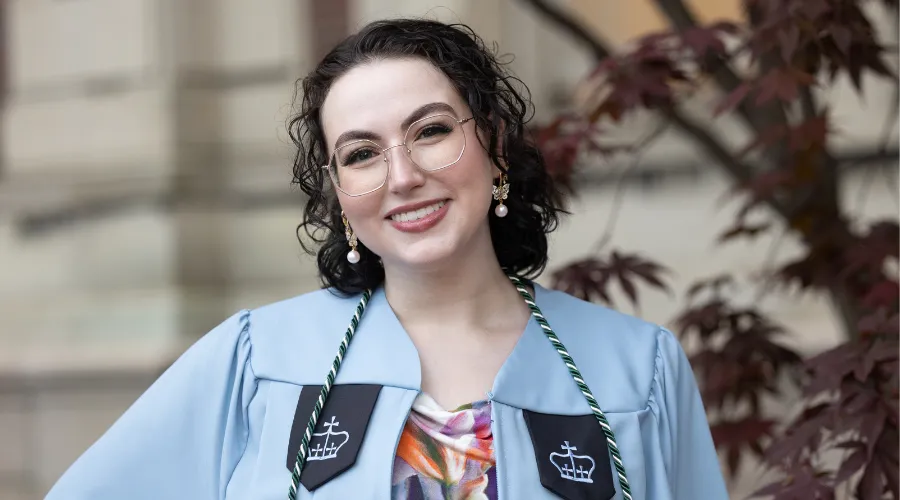
After being diagnosed with Obsessive Compulsive Disorder (OCD) in high school, Rachel Papirmeister ‘26GS thought that furthering her education was out of the question. After a few years in community college and life-changing treatment, Papirmeister rediscovered the enchantment of the classroom and began her GS journey. Now, a prolific researcher in machine learning and artificial intelligence, the great grad is looking to pursue a PhD, furthering her educational journey in ways she truly never expected.
Tell us about your path to GS.
Like many GS students, my professional and academic paths were nonlinear. The abridged story I tell people is that I worked in food service and childcare right after high school because I ‘wasn’t ready for college’ just yet, which is true. The longer version, however, is that it took me a very long time to figure out how to be a functional human. I lived with a great, invisible handicap: mental illness.
There is still a big stigma around mental disorders; I’ve never even read a Columbia graduate’s story where any student disclosed that mental illness was a big part of their journey. Even now, it feels vulnerable to admit this; it’s difficult for people to comprehend things they cannot see, and this is especially the case with visually imperceptible health conditions. With ‘mental’ illnesses, this archaic stigma seems to linger because there’s no physical, tangibly identifiable problem you can blame it on.
In middle school I was diagnosed with Obsessive Compulsive Disorder (OCD). What began as manageable, self-imposed inconveniences and minor rituals eventually grew into debilitating mental illness, completely overtaking my daily life and wellbeing. My illness became exacerbated in response to deaths in my family and traumatic experiences. As they struggled to understand what was happening to me, my parents transferred me into a different school more equipped to accommodate my disability and academic needs, and I acquired an individualized educational plan (IEP) by age 15.
Unfortunately, treatment interventions like therapy and medication still didn’t seem to help. I continued to deteriorate, beginning to experiment with substances for self-medication. At risk of being considered legally truant from school, my parents sent me to a residential treatment program at a psychiatric hospital in rural Wisconsin, for children and teens with severe anxiety disorders. I lived there for a total of five months during my junior and senior years of high school. This hospital is one of the reasons I am alive today.
After being discharged from the hospital for the final time, I had returned home, only to learn that my gym teacher had failed me for my inability to attend class (they knew I was hospitalized in another state). I had to take a physical education class at my local community college in order to graduate, so I was unable to walk with my friends or graduating class. I graduated a few months later that summer, in a mostly-empty auditorium with a handful of students from other public high schools that I didn’t know.
I decided to work after high school, taking classes here and there at community college; my family was supportive of this. I had plenty of ambitions, but most of my days remained overshadowed by my struggle with OCD. I thought about exploring trade schools or alternative methods to build a career; I contemplated becoming a makeup artist or sommelier, or enrolling in a culinary school. My parents were so relieved that I was functioning better than I did in high school that they never pushed me toward academia; they didn’t think I could handle it. Deep down, I think I knew all along that I would go back to school.
I began regularly attending community college right before the pandemic began. As my classes became remote, I accumulated a larger workload, taking more classes at once than I ever had before. Four years after high school, I finally rediscovered the enchantment of getting lost in a good book, the thrill of an intellectual discussion, and the satisfaction of following your curiosity’s whims. I quickly joined the honors program at my community college and obtained my associate’s degree the same year. I transferred to Columbia in the Fall of 2021.
I'm happy to normalize mental health (at least on an individual level) for the benefit of the broader Columbia community, and that I believe that normalizing mental health can save lives. I consider the normalization of mental health discussions essential for the safety and wellbeing of students.
What has been your greatest accomplishment at Columbia?
My proudest accomplishment at Columbia has been my AI research, on self-directed causal learning in sparse reward environments. I just submitted my first solo-author extended abstract to a conference, and I’m currently co-authoring a paper with my professor for another conference. This particular academic niche is so exciting to me because I know that the answers do not exist yet; the theoretical groundwork is still being laid, and developments arise just as rapidly as new questions and challenges. There’s still so much to learn.
I also feel empowered knowing that my role as an individual in such a fast-paced field has real ethical implications; I think you want the people studying AI to be the most critical of it. I believe that I have a moral imperative to work in this field now, knowing that others may not care as much as myself about human-in-the-loop feedback or safety guardrails in machine learning models. It’s important to me that human ethics remain encoded in the technology we build, and I want to reflect that in my own work.
Tell us about a professor at Columbia that was instrumental to you during your time at GS.
I could not have made it this far without my academic advisor Lauren Manzino, Professor Ken Light of the Psychology department, and Professor John Wright of the Slavic department. Most of all, I must thank Professor Mark Santolucito of the Computer Science department for taking a chance on me a year ago, after our very first meeting when I was still a student in his COMS 1002 class. His unending support, willingness to learn with me, and encouragement to try what seems impossible has led me to cultivate a career that I could not have imagined a year ago.
The same week we met, I asked Professor Santolucito what makes an undergraduate thesis project truly great. He responded via email: “the distinguishing feature of a good thesis and a mediocre one is when the project becomes more than ‘just’ a school project, and the student aims to have an impact on the real world.”
What advice would you give to a student who's about to start their GS journey?
My time at Columbia was not easy; I faced new challenges here, with higher stakes than ever before. To succeed at this university, my top recommendations are to get out of your comfort zone, connect with your professors regularly, work hard and with intention, and try things even if you think you’re unqualified; don’t let imposter syndrome stop you from anything. Also, get involved in student life programming, like staffing the New Student Orientation Program (NSOP). It's genuinely fun, and also a wonderful way to serve the GS community.
While the road to success is winding and labyrinthine, ‘College Walk’ on the Morningside campus is a straight path where you can learn from your obstacles and mistakes. You will definitely mess up, but when you mess up again, you will mess up less. Keep doing this until you graduate.
What are your plans for after graduation?
After graduation, I will be working in the AI industry while continuing my research on human-centric machine learning. My long-term goal is to pursue a PhD program.