
From Archaeology to Medicine: How a Health Crisis Led to a Major Career Change
Lydia Jacob ‘26PBPM reflects on how proud she is of the Columbia student body and the ways the program has facilitated her career change.
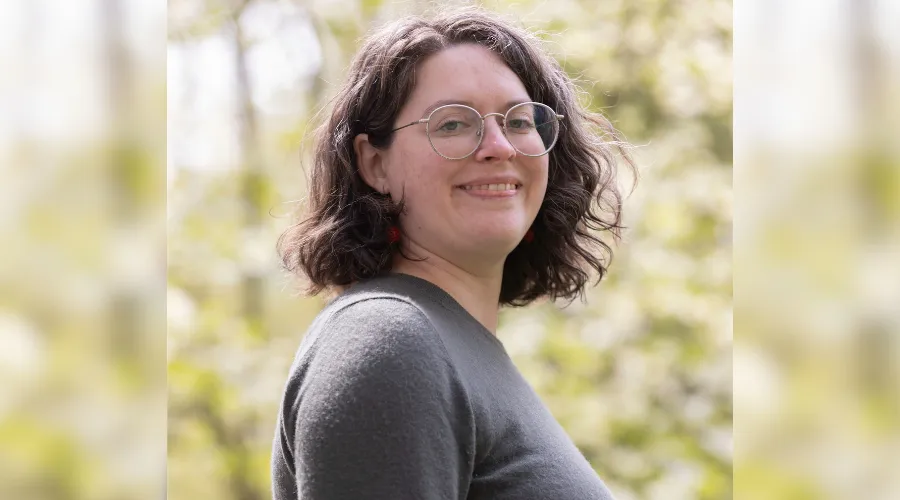
Lydia Jacob ‘26PBPM was too curious about the human body not to pursue medicine—after facing chronic illness and becoming an aunt, the archaeologist knew that a career shift was right for her. She’s so proud to be a part of the Postbac Premed Program and finds her proudest moments come from all the incredible accomplishments of her peers. Her time in the Postbac Program and her and her husband’s journey to New York felt like a homecoming in more ways than one.
Tell us about your path to GS.
Raised in both Minnesota and Texas, my undergraduate years were spent studying Linguistics and Anthropology at UT Austin. I found a stepping-stone in a brief term of service in a conservation corps based in Flagstaff, AZ, and shortly after began my career in cultural resource management (archaeology).
My role changed over the years from archaeological field technician to assistant crew chief to crew chief, monitor and lab assistant. Fieldwork brought me from deep in the woods and power line corridors spanning upper New England to islands off the coast of Maine, most of it alongside my husband, New Yorker, artistic muse, and fellow archaeologist, Les. Outside of work I spent a lot of time painting, inspired by landscapes, figures, and medieval illuminations as well as travelling to visit family that lives scattered around the U.S.
Both gradually and all of a sudden, Les and I found ourselves facing chronic illnesses together. They comprised a confusing mix of inconsistent waves of symptoms as well as several unpredictable onsets of emergencies.
Ultimately, those experiences with health crises as well as becoming an aunt for the first time, impacted me deeply enough to make me too curious about the human body not to pursue medical school. The Columbia Postbac Premed program, as a pre-established path for career changers, has been the ideal start on that new journey, providing a homecoming to New York while I prepare for the next steps.
It feels significant to me that my transition from Arizona to working in New England was not linear, but consisted of basically a loop around the country.
A conservation corps friend let me tag along on a camper van road trip from Arizona to Seattle, Washington where I stayed with my amazing aunts (who happened to have also been career clinicians). From Washington, I took an Amtrak train across to Minnesota. From there, my parents helped me buy my first car, which I drove through Wisconsin and Canada to reach Maine for my first archaeology job. Years later, having lived in or experienced much of the southwest, midwest, west coast, Pacific Northwest, and northeast, arriving in New York felt like coming home for me as well as my husband who actually grew up here.
Obviously I can't convey the complete story, but further inspiration for pursuing a career in medicine comes from family legacies in healthcare. My maternal grandmother was a nurse. My maternal grandfather was a physical therapist. I have aunts who have been nurses, naturopaths, and a dermatologist. My mother-in-law once took part in a Postbac Premed program herself at SUNY Purchase before pursuing alternate paths. My husband's grandfather, Dr. Harry Jacob, is a hematologist. And we just lost one of my biggest cheerleaders, my husband's grandmother, Diana Cosimano (Nanny), whose career was as a social worker.
What has been your proudest moment at Columbia?
It has been an honor to be in the company of Columbia's greater student body, particularly alongside my fellow postbacs. It's an inspiration to start seeing my postbac classmates being accepted into medical schools, and I couldn't be prouder of them.
Successfully completing these courses and entering my thirties at the same time has been empowering, teaching me new ways to challenge myself and grow.
Tell us about a group at Columbia that was instrumental to you during your time at GS.
My experience in this program would not have been the same without the solidarity of the "Elders" group for premeds over 30, the friendships that bloomed from study groups, and the expert advice and perspectives shared by my advisor, Dean Allen. I am so grateful to all of them for being part of this with me.
What advice would you give to a student who's about to start their GS journey?
I would recommend taking advantage of as many opportunities as possible throughout the postbac program, as they have both obvious and hidden value. There is a culture of generosity of time and knowledge to be found between the lines. In addition, you never know who you'll meet or what might speak to you once you've done the "showing up" part.
What are your plans for after graduation?
In the next year, I will be taking the MCAT and entering the medical school application cycle. Additionally I'll still be close by, serving on the Postbac Premed Student Council as the Internal VP of Premedical Development, and keeping busy rounding out my own personal premed development.
I could not have been here and done this without the amazing support system I have in the Jacob, Cosimano, White, Cullen, and Brahier families.
Les and I also have two amazing fluffy cats, Tabasco and Horseradish, who we love very much and were able to adopt once we stopped both doing full-time fieldwork.