
Model Advocates
New York State’s groundbreaking Fashion Workers Act—which went into effect in 2025— has deep roots at GS.
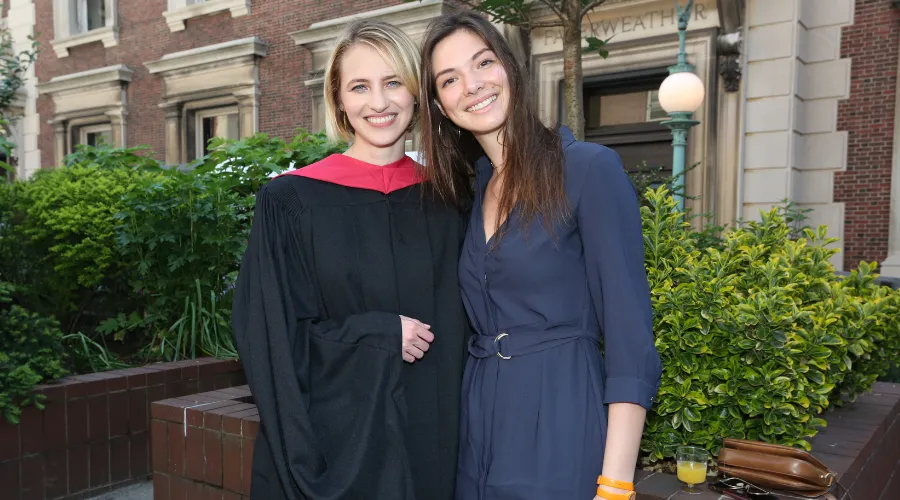
In her senior year of high school, Dorothee Grant ’21GS received an unexpected Instagram message from a premier modeling agency. Still sweaty from cross country practice, she had her mom snap a few photos in their upstate New York yard and sent them in.
Within weeks, the class valedictorian had signed a three-year contract. Instead of college, Grant jetted around the world, getting chauffeured to castings and photo shoots, and walking the runways of New York, Paris, London, and Milan.
Then the bills started arriving.
Grant’s agency charged her for everything from mandatory haircuts to a consultation with a nutritionist to help her slim down— even though she had already been pressured to diet to a dangerously low weight.
“I thought that I was getting these things paid for,” Grant recalled.
Grant had no control over or insight into what she earned. She sometimes completed a month of work only to learn she owed the agency money.
A Movement Born at GS
It was only when Grant entered Columbia’s School of General Studies and connected with former model Sara Ziff ’11GS that Grant began to understand that her tribulations were part of systemic exploitation in the modeling industry.
After living through her own frustrations and abuse as a model, Ziff enrolled in GS as a political science major and began learning about labor and community organizing. With mentorship from Professor Dorian Warren, former codirector of Columbia’s Program on Labor Law and Policy, Ziff started the Model Alliance to fight for the rights of a group of workers who typically garner little sympathy.
“The modeling and fashion industries appear to be very glamorous,” Ziff said. “But when you pull back the curtain, the reality is that the modeling industry relies on predominantly very young immigrant women and girls, often just teenagers, who have little control over their working lives and are often put in predatory situations.”
Ziff found a longtime ally and mentor in Warren, who helped her understand that “we deserve to have rights and protections like anyone else who works for a living.” Warren, who left Columbia in 2015, continues to serve on the Model Alliance Advisory Board.
Beyond models, Ziff wanted to fight for the rights of all fashion workers, "from the runway to the factory floor.” To that end, Ziff and the Model Alliance have fought for garment workers’ rights in Bangladesh and other countries.
For three years, the Model Alliance pushed New York State legislators to pass the Fashion Workers Act (FWA), which became a first-of-its-kind law establishing labor rights for models in 2025. The Fashion Workers Act regulates modeling agencies, which have typically required models to sign a power of attorney agreement, allowing the agency to sign contracts on the model’s behalf. Models often didn’t consent to—or even see—the terms of their own work contracts.
“This effectively makes you blind to your own business dealings and finances,” Ziff explained. “It is a huge amount of power to hand over to someone. In addition, the modeling agencies have claimed that they have no fiduciary responsibility to the young people they represent. This creates an environment of lack of transparency, coercion, and a great deal of abuse.”
Grant, who serves on the Model Alliance Workers Council, recalls taking the train to New York City while she was still in high school to pose for Cosmopolitan magazine—only to find out later that she would not be paid for the job. The same thing happened when she worked as a presenter at the Met Gala.
Abuse Beyond the Financial
Models are also routinely put in physically dangerous or humiliating situations, such as being forced to change clothes in public areas, where it is not uncommon for someone to photograph them without their consent. Agencies frequently send models— who sometimes do not earn enough to buy meals—to dinners and clubs as entertainment for wealthy businessmen. In such situations, models are clearly vulnerable to sexual harassment and assault.
“That sort of behavior has been normalized in the industry, and you are considered difficult to work with if you complain about it,” Ziff said.
When writing her thesis at Columbia’s Mailman School of Public Health, Sydney Giordano ’20MPH focused on labor exploitation in a workforce that is miles removed from the Met Gala: makers of garments in Bangladesh. Yet when she became the Model Alliance’s associate director, Giordano was struck by the parallels between models and seamstresses.
“Conditions are different; the socioeconomic conditions are different,” Giordano said. “But on both sides of the supply chain, there are issues around working for free or very low wages, delayed payments, pressure to work long hours, exploitative contracts, and a really uneven power dynamic between the companies and the workers.”
Initially, the FWA was written to cover fashion workers beyond models, including photographers and hair and makeup artists, Ziff said. Unfortunately, its supporters did not get everything they wanted, and the final bill is limited to models and would-be models.
The FWA is not Ziff’s first legislative battle. After she founded the Model Alliance in 2012, the organization helped pass the Adult Survivors Act (ASA), which established a one-year window for New York victims of sexual assault to sue their abusers, no matter when the crimes happened.
Under the ASA, Ziff filed a lawsuit accusing Fabrizio Lombardo, an associate of Harvey Weinstein, of raping her in a hotel room when she was 19. According to the suit, Ziff’s agency arranged her meeting with Lombardo.
“The reality is that the modeling industry relies on predominantly very young immigrant women and girls, often just teenagers, who have little control over their working lives and are often put in predatory situations.”
Ziff also made a documentary, 2009’s Picture Me, with filmmaker Ole Schell, about the darker side of high-fashion modeling.
Enrolling in GS was a turning point in Ziff’s life that helped her reframe the frustrations of her fashion career from personal struggles to systemic issues that could be changed.
“Coming from the fashion industry to an academic environment where I was valued for my ideas, not just my measurements, was incredibly refreshing,” she said.
New Legal Protections
After more than a decade of organizing and three years of crafting the bill and communicating with state legislators, the Model Alliance won a huge victory in getting the FWA passed. It encodes the following protections, among others, into law:
• Fiduciary duty. While attorneys are required by law to act as fiduciaries, acting in their clients’ best interest, modeling agencies have in the past been free to take actions that don’t help their models at all. The FWA requires agencies to negotiate contracts in models’ best interest.
• Contract transparency. Agencies now have to disclose to models key details, including pay rate, before a job begins.
• Power of attorney. Giving the agency the power to sign contracts on a model’s behalf is now optional and revocable.
• Safety. Agencies can’t send models to jobs that pose an unreasonable risk of danger.
• Fees and expenses. Agencies must receive written approval before paying expenses that will later be charged to the model.
• Nudity. Agencies can’t create or use nude or otherwise explicit photos without the model’s voluntary consent.
• Harassment and retaliation. Agencies have to establish company policies prohibiting inappropriate behavior toward models and protecting models who report problematic behavior from retaliation.
• Artificial intelligence. An agency can’t create or use a digital replica of a model without written consent.
The provision on artificial intelligence replicas makes the FWA one of the first laws anywhere to address AI in a labor context. Already, models have found AI-manipulated versions of their faces used online without their consent.
“We see the Fashion Workers Act as a template for what could be done in other states and fashion capitals around the world.”
Grant, who works in AI after having studied computer science at Columbia, praised that section of the bill as threading the needle between the potential of AI and necessary protections.
“Imagine a world where agencies don’t have to deal with models anymore,” Grant said. “They could just take your likeness and manipulate it for any brand. Requiring consent for that is a huge way of ensuring you don’t have situations where your digital replica is doing things that you would not want.”
Enforcing the Ground Rules
The Model Alliance also hopes that other jurisdictions will see these changes in New York and be inspired to protect fashion workers as well.
“We see the Fashion Workers Act as a template for what could be done in other states and fashion capitals around the world,” Ziff said.
In New York, the Model Alliance has been busy educating workers that they now have an avenue for reporting violations to the state Department of Labor and connecting some with attorneys for potential lawsuits. For years, the organization has been fielding calls about abuses from the field through its worker support hotline.
“In the past, when people would come to us through our support line, it would feel like putting a Band-Aid on a gaping wound. Without the law on their side, there wasn’t a lot that we could do,” Ziff said. “But now when people come to us, we can say, ‘Yes! You do have rights and protections.’”